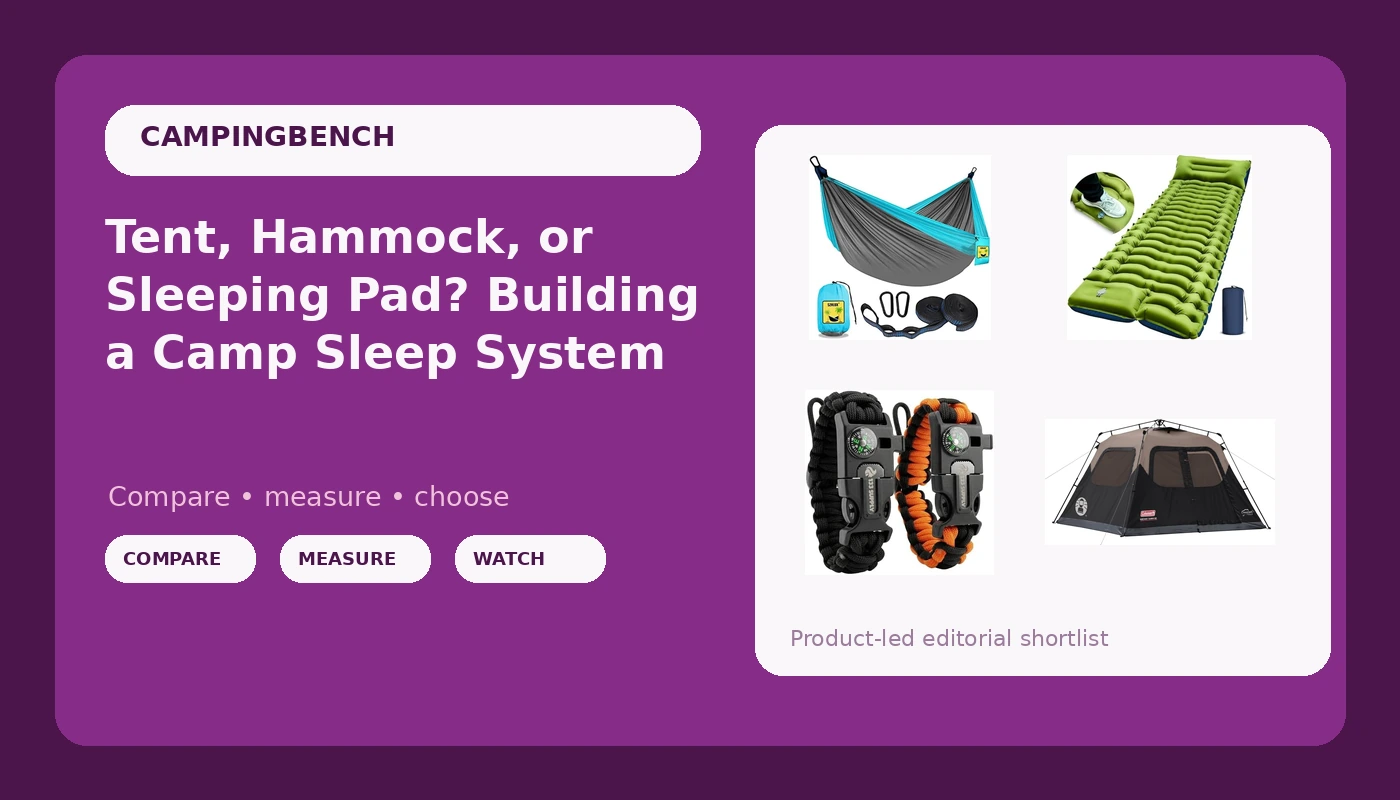
A camping sleep system is not a single purchase. It is a stack of decisions about shelter, insulation, and the small odds and ends that keep a night from turning into a story you tell for years. Most people start by shopping for a tent, buy one, and stop there. Then they find out at 2 a.m. that the ground is colder than the air, that the campsite has no flat spot wide enough for a footprint, or that the shelter they chose weighs more than everything else they loaded into the car combined.
That is the reader problem this guide addresses. The four products below cover four different jobs in the same stack: a large instant tent for car camping, a hammock for sites with trees, an inflatable sleeping pad for the surface you actually lie on, and a paracord bracelet that rides on your wrist until something needs tying, patching, or lashing. None of them replaces the others. Knowing which job you are shopping for is the whole exercise.
Related: How to Choose a Backpacking Tent Without Overpaying →
Quick answer
Build the shelter around the trip, not the other way around. If you drive to the site and sleep several people, a large instant tent is the practical choice because packed size and weight matter less than floor area and setup time. If you are carrying everything on your back, packed size and weight decide the purchase before comfort does. If the site has trees and the forecast is mild, a hammock can replace the tent entirely. Underneath all of it, you still need a sleep surface that insulates, because cold ground pulls heat out of a sleeping bag far faster than cold air does. Cordage is the cheap insurance that turns a broken guy line or a torn strap into a five-minute fix instead of a ruined trip.
Four useful options
| Model | Best fit | What stands out |
|---|---|---|
| Coleman 4/6/8/10 Person Instant Camping Tent with 1-Minute Setup | Car camping and basecamp trips with multiple sleepers | Instant-pole design advertised for a one-minute setup, offered in 4, 6, 8, and 10 person capacities |
| SZHLUX Camping Hammock Double & Single Portable Hammocks with 2 Tree Straps and Attached Carry Bag | Sites with trees, warm weather, lounging and napping | Double and single configurations, two tree straps included, attached carry bag |
| FUN PAC Camping Sleeping Pad, Ultralight Camping Mat with Pillow, Built-in Foot Pump Inflatable Sleeping Pads Compact for Camping Backpacking Hiking Traveling Tent, Single, Green | One sleeper who wants an inflatable pad without a separate pump | Built-in foot pump and an integrated pillow, single size, green |
| Tactical Paracord Survival Bracelets | Repair, lashing, and general utility backup | Worn cordage that doubles as a bracelet |
Car camping base: Coleman 4/6/8/10 Person Instant Camping Tent with 1-Minute Setup
The trade-off here is straightforward and worth naming out loud: a tent this size is not a backpacking tent, and it should not be judged as one. It is heavy, it takes up trunk space, and it assumes you are sleeping within walking distance of a vehicle. What you get in return is headroom, a floor big enough for real beds or a pile of duffels, and a pitch that does not require you to thread poles in the rain while your family waits in the car.
The capacity numbers deserve a caveat. A "4 person" rating describes four sleeping bags laid shoulder to shoulder, not four people plus their gear. If you want to stand up, keep bags inside, or bring a cot, size up one tier. For two adults who want room to move, a 4 person tent is comfortable; for a family of four with gear, a 6 person is the more realistic pick, and the 8 and 10 person options exist for exactly the groups that keep outgrowing the smaller ones.
The packable shelter: SZHLUX Camping Hammock Double & Single Portable Hammocks with 2 Tree Straps and Attached Carry Bag
A hammock solves the problem tents cannot: uneven, rocky, root-covered, or sloping ground. If you can find two suitably sized trees, the site is flat by definition. That is a real advantage on packed summer weekends, when every level patch has already been claimed.
Two things people get wrong. First, they hang the hammock too tight and too flat. A hammock wants a gentle sag, roughly a 30 degree angle from the straps to the hammock body, so you lie on the diagonal rather than folded in half like a banana. Second, they treat the hammock as the whole sleep system. It is not. Air moves under a hammock and steals heat from your back, which is why hammock campers use insulation underneath, whether that is an underquilt or a pad placed in the hammock. The included tree straps also matter more than they look: wide straps protect bark, and using proper straps instead of rope is a Leave No Trace basic. Confirm your local land management rules before you hang anything, because some areas restrict hammock use outright.
The sleep surface: FUN PAC Camping Sleeping Pad, Ultralight Camping Mat with Pillow, Built-in Foot Pump Inflatable Sleeping Pads Compact for Camping Backpacking Hiking Traveling Tent, Single, Green
A sleeping bag does not insulate you from the ground. It insulates you from the air, and the air pocket it traps is compressed flat wherever your body weight presses it into the dirt. That is why the pad matters. The measure to look for is R-value, the insulation rating of the pad. Higher numbers mean a warmer night. A thin summer pad is fine in July and miserable in October, and the difference between a good night and a bad one is usually the pad, not the bag.
Built-in pumps are a genuine convenience feature, especially for anyone who has gotten lightheaded inflating a pad by mouth at altitude. The trade-off is that an integrated pump adds a little bulk and a few grams, and the pump mechanism is one more thing that can fail. The integrated pillow is a similar bargain: it saves you packing a separate pillow, but side sleepers and anyone with neck issues should test whether the built-in height works for them before committing to a multi-day trip with no backup.
The small insurance policy: Tactical Paracord Survival Bracelets
Every gear list has a category that only matters when something else has already gone wrong. Cordage is that category. A guy line that snaps in wind, a bear bag line that is fifteen feet too short, a tent pole splint, a shoelace, a replacement zipper pull, a clothesline between two trees: all of them are solved with a few feet of cord and none of them are solved with a credit card at a trailhead.
Paracord bracelets are a compromise, and it is worth being honest about that. The cord is woven tight, so unwinding it takes a couple of minutes and leaves you with a shorter working length than a dedicated hank of cord would give you. What you gain is the guarantee that it is actually on your body. A repair kit in the trunk does nothing for you four miles up a trail. If you want maximum utility per ounce, carry a proper length of cord in your pack and wear the bracelet as backup. If you want the thing that is always there, the bracelet is the answer.
Prices and availability may change. Product images, names, and retailer links must be matched by verified ASIN. Do not state a current price, rating, stock status, or measured result without current evidence.
How capacity and comfort ratings actually work
Manufacturers describe tents by how many sleeping bags fit on the floor, side by side, with nothing else in the tent. That is the definition behind every "2 person," "4 person," and "6 person" label. It assumes sleeping pads that are roughly 20 inches wide and sleepers who do not mind touching shoulders. Add a duffel bag, a cooler, a dog, or a desire to sit up without folding in half, and the honest capacity drops by at least one person. The practical rule: buy for the number of people plus one tier if you want gear inside, or if anyone in the group is tall or restless.
Sleeping pads have a similar translation problem. The R-value scale runs from roughly 1 for a bare summer pad to 5 and above for winter use. Values in the 1 to 2 range suit warm-weather trips. Values around 3 to 4 cover three-season camping. Anything above 5 is winter territory. Inflatable pads also have to be inflated to the right firmness: too soft and your hip bottoms out against the ground, too firm and you sleep like you are on a table. Most people land on firm, then let a little air out until their hip clears the ground by a finger's width.
Hammocks follow a different logic. There is no floor area to argue about, but there is a hang angle, a strap width, and a critical insulation question underneath. Treat the hammock as a shelter and the pad or underquilt as the sleep system, exactly as you would with a tent.
Matching the shelter to the trip
- Decide how you are arriving. If a vehicle is within walking distance of the tent pad, weight and packed size are low priorities and interior space wins. If you are carrying it, the calculation flips completely.
- Count the sleepers honestly, then add one tier. Children grow, adults sprawl, and gear has to go somewhere that is not the middle of the floor.
- Check the site, not just the weather. Trees or no trees decides whether a hammock is even an option, and local rules may restrict hanging regardless of what the trees suggest.
- Set your insulation target before you shop. Warm summer nights, three-season shoulder seasons, and winter all demand different R-values, and the pad is the piece that determines which one you are actually prepared for.
- Pack a repair layer. Cordage, a spare stake, and a patch kit weigh almost nothing and cover the failures that would otherwise end a trip early.
Practical guidance that saves a night
- Pitch the tent once at home before you rely on it. A driveway test costs twenty minutes and reveals missing stakes, confusing pole sleeves, and a footprint that does not match the floor.
- Put something between your pad and the ground. Even a thin groundsheet reduces abrasion and punctures, which is the most common way an inflatable pad dies.
- Inflate the pad fully, then adjust. Underinflation is the number one cause of a cold, achy night on an otherwise adequate pad.
- Hang hammocks with wide tree straps on living trees of adequate size, and never on dead limbs or thin saplings. Bark damage is a real and permanent impact.
- Keep cordage and a small repair kit on your person or in the top of your pack, not at the bottom. Repairs happen at the moment of failure, not at camp.
- Practice leaving the site better than you found it. Pack out every scrap of cord, tape, and packaging, including the little bits that are easy to miss in grass.
Which option should you choose?
Choose the Coleman 4/6/8/10 Person Instant Camping Tent with 1-Minute Setup when you are car camping or basecamping with several sleepers and want floor area plus a fast, simple pitch. Choose the SZHLUX Camping Hammock Double & Single Portable Hammocks with 2 Tree Straps and Attached Carry Bag when the site has suitable trees, the weather is mild, and you would rather not fight for a level patch of ground. Choose the FUN PAC Camping Sleeping Pad, Ultralight Camping Mat with Pillow, Built-in Foot Pump Inflatable Sleeping Pads Compact for Camping Backpacking Hiking Traveling Tent, Single, Green when you need a compact sleep surface with its own inflation method and do not want to carry a separate pump or pillow. Add the Tactical Paracord Survival Bracelets when you want cordage that stays on you, and treat it as backup rather than as your entire repair kit.
The caveat is the same for all four: this is a decision framework built from product names, stated configurations, and general camping practice, not from instrumented field testing. Capacity ratings, R-values, and hang angles are industry conventions with real limits, and the right choice depends on your trip, your climate, and how much you are willing to carry.
The bottom line
A camping sleep system is a chain of layers, and the weakest link decides your night. For car camping, start with a tent sized one tier above your headcount. For backpacking or tree-lined sites, a hammock plus real under-insulation covers ground you could not otherwise use. For everyone, the pad underneath is not optional, because insulation from the air means nothing if the ground is draining heat out of you. Finish the kit with cordage you actually carry, then go sleep outside and find out what your own version of the setup needs.