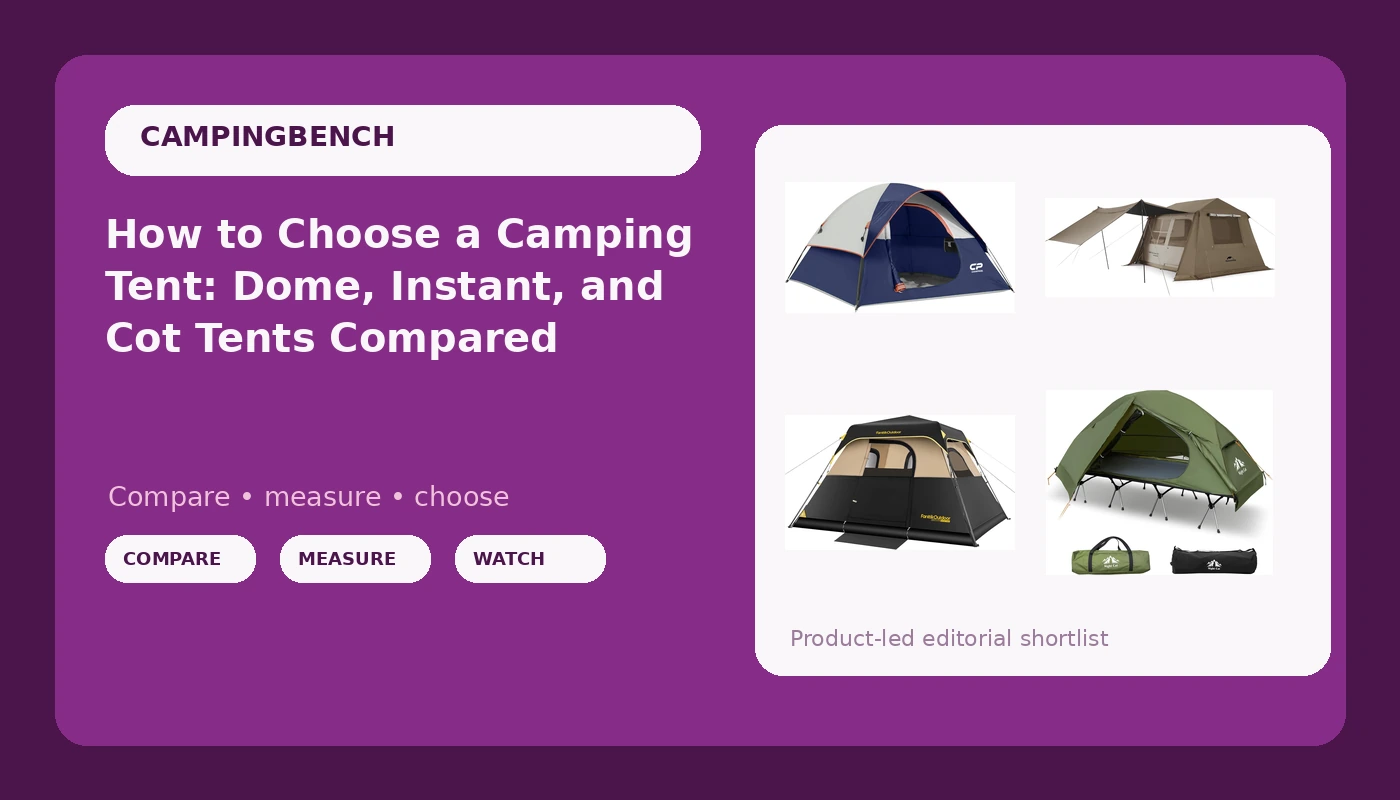
Choosing a tent is less about brand loyalty than about matching a shelter to the trip you actually take. Most people searching for how to choose a camping tent start with capacity, then get stuck, because the category splits into shapes that solve genuinely different problems: dome tents that pack small, cabin tents that stand tall, instant tents that unfold fast, and off-ground designs that keep you away from the dirt entirely. The four tents below cover that spread, from a compact three-person dome to a large instant cabin to a one-person cot tent. None of them is an ultralight backpacking shelter, and that is fine. These are car camping tents, the kind you drive to a site, pitch within sight of the vehicle, and live in for a weekend. What follows explains what each style does well, where each one gives something up, and how to decide which trade-off fits your trip.
Related: Tent Capacity Ratings Explained Without the Marketing Math →
Quick answer
Buy capacity for one more person than you sleep, insist on a full rainfly if you camp anywhere with real weather, and pick the pitch style that matches how much patience you have left after a long drive. A dome is the most packable and the most wind-shedding shape. A cabin tent gives you standing room and space for cots or air mattresses. An instant tent trades packed size and weight for speed. A cot tent removes the ground entirely and suits one person who wants to sleep off the floor. Among the four options here, the CAMPROS CP is the compact three-person dome, the Naturehike Village is the large instant cabin, the FanttikOutdoor is the group instant tent, and the Night Cat is the solo off-ground option.
4 useful options
| Model | Best fit | What stands out |
|---|---|---|
| CAMPROS CP 3 Person Tent, Waterproof Dome Tents for Camping with Rainfly | Solo or two-person car camping | Three-person dome with an included rainfly |
| Naturehike Village Instant Tent | Family basecamps that want standing room | Instant cabin design with a full rainfly, offered in 4 person and 8 person sizes |
| FanttikOutdoor 4/6/8/10 Person Instant Tent | Groups who want a fast pitch | Instant construction advertised at a 60 second setup, sized for 4 to 10 people |
| Night Cat Camping Cot Tent | One person sleeping off the ground | Combined cot and tent with a waterproof shell, 27.5 inch width |
The compact dome: CAMPROS CP 3 Person Tent
A dome earns its place by being forgettable in the best way. It packs into a small stuff sack, it sheds wind because there is no flat wall for gusts to push against, and it needs less open ground than a cabin. The trade-off is headroom: you sit up in the middle and lean over near the walls. A three-person dome used by two people is a comfortable arrangement, with room for two pads and a duffel at the foot. Used by three adults, it becomes a sleeping-only shelter with gear left in the car. The rainfly matters more than the shape here, because a fly that covers the roof but leaves the walls bare is decoration, not weather protection.
The family cabin: Naturehike Village Instant Tent
Cabin tents solve a problem domes cannot: they let you stand up, change clothes, and set up cots without crawling. The cost is everything that comes with more fabric. Larger panels catch more wind, so a cabin wants better staking and a more sheltered site. The packed size is bigger, and the tent is heavier, which is why cabins live in car camping and stay out of a backpack. A full rainfly is the feature worth checking on any cabin, since tall vertical walls are exactly where rain finds its way in. For a family that returns to the same site and leaves the tent up all weekend, the space is worth the bulk.
The fast-pitch group tent: FanttikOutdoor Instant Tent
Instant tents exist because pitch time is a real cost. Arriving after dark, in wind, with tired kids, is when a twenty minute setup turns into a bad memory. Pre-attached poles remove the step where you thread a pole through a sleeve and hope you did not miss the grommet. The trade-off is packed length and weight, since folded pole assemblies do not compress the way loose poles do, and long folded bundles are awkward to store in a small car. Instant tents also reward a little practice at home, because the folding sequence when you pack them away is less intuitive than the setup.
The off-ground solo: Night Cat Camping Cot Tent
Sleeping off the ground changes a night in ways a pad cannot. Cold ground pulls heat out of a sleeping bag all night, and lumpy, rooted, or wet ground stops mattering once you are a foot above it. A cot tent is also a self-contained system: no separate pad, no separate cot, no figuring out how the two fit together inside a small floor plan. The limits are obvious. It is a one-person shelter, so it does not scale to a family, and it sits tall enough that wind exposure and staking matter more than they would for a low dome. It suits a solo camper, a taller sleeper, or anyone who has stopped enjoying the ground.
Prices and availability may change. Product images, names, and retailer links are matched to verified listings. No current price, rating, stock status, or measured result is stated here without current evidence.
What the tent categories actually mean
Dome tents are defined by their geometry. Two or more poles cross at the top, the fabric slopes away on all sides, and the result is a shape that sheds wind and rain without needing a flat wall to hold it up. Because the poles are usually the same length and the shell is roughly symmetrical, domes pack small and pitch with few decisions. The trade-off is interior volume: usable space tapers as you move away from the center, so a dome rated for three people sleeps two comfortably and three only if everyone is on a sleeping pad with nothing else inside.
Cabin tents invert that trade-off. Walls rise almost vertically, so the interior is closer to a box than a cone. Standing height, room for cots, and a place to put a duffel without tripping over it are the payoff. The penalty is weight, packed size, and wind exposure, because a tall flat wall is a sail. Cabins are also more sensitive to how well they are staked and guyed out.
Instant tents are a construction method rather than a shape. The poles stay attached to the shell, often through a hub system, so the tent unfolds as a single unit and locks into place. Setup becomes a sequence of pulls and clicks rather than threading. This is a genuine convenience, and it is also why instant tents tend to weigh more and pack longer than comparable pole tents of the same size.
Cot tents combine two pieces of gear into one product. The frame lifts you off the ground and the shell encloses you. That solves ground cold, ground moisture, and the puzzle of how to keep a sleeping pad from sliding off a cot. It also fixes the capacity at one person.
Capacity, rainflies, and weather
Capacity ratings describe sleeping space, not living space. A manufacturer counts bodies on pads, side by side, with no gear. Real trips include a duffel, a lantern, boots, and a water bottle. Sizing up by one person is the simplest correction, and it costs less than buying a second tent later.
Rainfly coverage is the spec worth reading closely. A partial fly protects the roof and leaves the walls exposed. A full fly extends down the sides and over the doors, which is what keeps wind-driven rain from reaching the inner tent. Look at how far the fly reaches and whether the door area is covered.
Seams are the other weak point. Factory seam tape can fail over seasons of use, and a tent that has been stored damp will degrade faster than one that was dried before packing. A tube of seam sealant and an afternoon of work is cheap insurance on any tent you plan to keep.
- Decide how you sleep: on the ground, on a pad, or off the ground on a cot.
- Count the people who will actually sleep inside, then add one to the capacity you shop for.
- Choose a shape based on the site: a dome for exposed or small pads, a cabin for space and standing height.
- Check rainfly coverage and seam treatment before you check anything cosmetic.
- Weigh the packed size against your vehicle and your storage, because a tent you cannot fit is a tent you will not bring.
What to check before you buy
- Confirm the packed dimensions against your trunk or roof box, especially for instant tents with long folded pole assemblies.
- Read the rainfly description and make sure the coverage is full rather than partial.
- Check the floor area in square feet against the number of sleeping pads you plan to place inside.
- Look for a bathtub floor, meaning the floor material curves up at the edges instead of meeting the wall in a flat seam.
- Plan for stakes. Most tents ship with basic stakes, and soft or sandy ground is where cheap stakes bend on the first night.
Which option should you choose?
Choose the CAMPROS CP 3 Person Tent when you want a small, simple dome for one or two people and you would rather pack light than stand up inside. Choose the Naturehike Village Instant Tent when the tent is a basecamp that stays pitched for the weekend and you want standing room plus a full rainfly in a 4 or 8 person size. Choose the FanttikOutdoor Instant Tent when you are pitching for a group and speed matters more than packed size. Choose the Night Cat Camping Cot Tent when you are camping solo and want to sleep off the ground in a single self-contained unit.
The caveat is the same for all four: a tent is a system, and the fly, the stakes, and the seam treatment decide how it performs in weather. Shape and capacity decide how it fits your trip.
The bottom line
Match the tent to the trip rather than to the spec sheet. A three-person dome covers most two-person car camping. A cabin makes sense when the tent is a destination in itself. An instant tent earns its bulk when setup speed is the bottleneck. A cot tent is the answer for one person who is done sleeping on the ground. Check the rainfly, size up the capacity, and confirm the packed size fits your vehicle before you commit.