A car camping setup fails in one of two ways. Either you load so much that packing the car becomes the whole trip, or you load so little that the second night is cold and the third night is a drive home. I have watched both happen in campgrounds from the Deschutes to the Olympic Peninsula, and the fix is almost never more gear. It is picking a few things that do their jobs and leaving the rest in the garage.
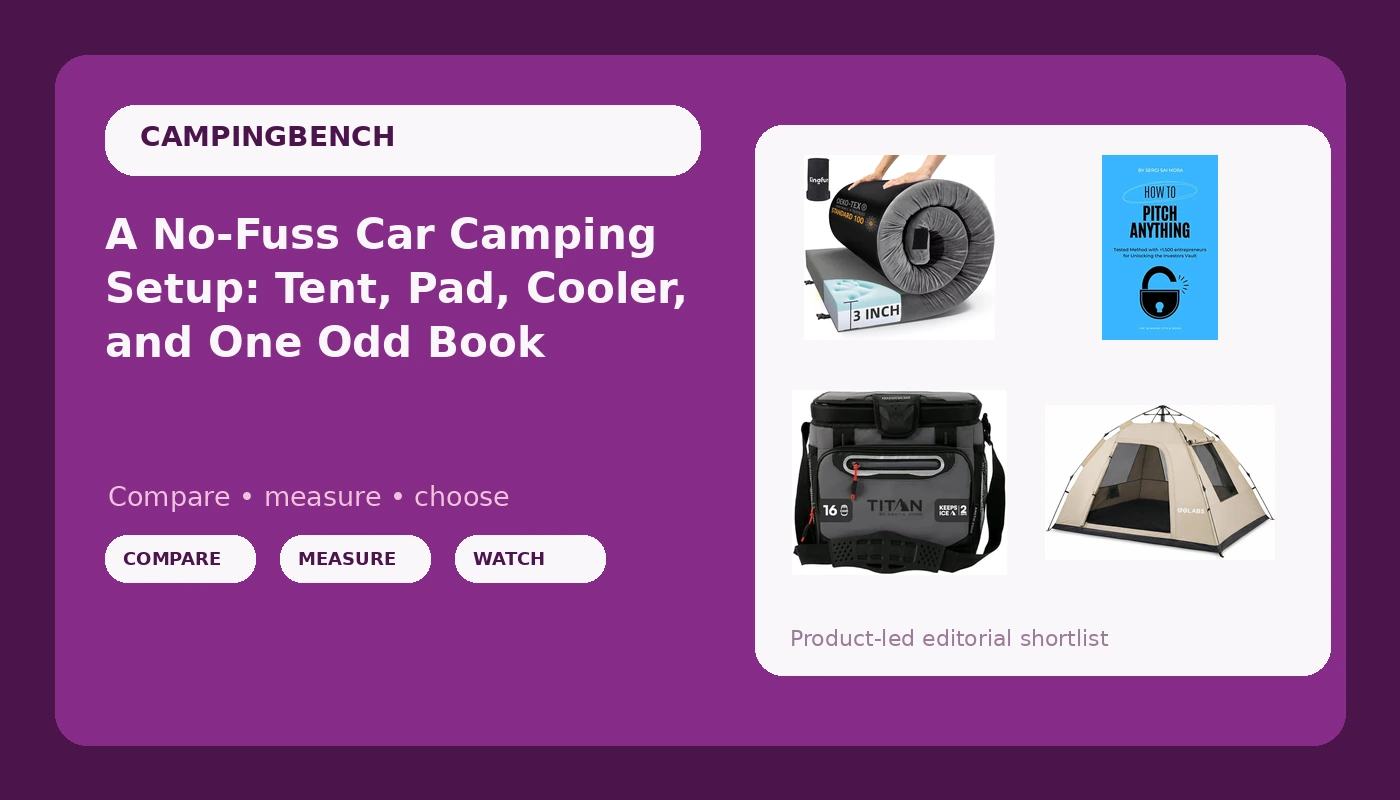
This guide walks through a simple car camping setup built from four specific listings: a pop-up tent, a thick memory foam sleeping pad, a zipperless hard cooler, and one book that is not camping gear at all. The point is not to sell you a pile. The point is to show what each piece is for, where it trades off, and which trips it actually suits.
Related: Pitch Time: The Number That Decides Whether You Stay Dry →
Quick answer
For a straightforward car camping setup, cover shelter first, then sleep, then cold storage. The Golabs Pop Up Camping Tent for 2/3 Person handles the shelter with a pre-attached pole design described as quick setup. The Kingfun 3 Inch CertiPUR-US Memory Foam Camping Mattress Pad handles sleep comfort with a thick foam layer instead of an air pad. The Titan Zipperless HardBody Cooler handles food and drinks with a lid that has no zipper to fail. The fourth listing, How to Pitch Anything, is a business book about pitching to investors, not a camping product, so treat it as a camp read rather than gear. Everything below comes from the listings themselves. Nothing here is a measured field result.
Four useful options
| Model | Best fit | What stands out |
|---|---|---|
| Golabs Pop Up Camping Tent for 2/3 Person | Car camping shelter for two or three sleepers | Pre-attached pole design the listing describes as quick setup |
| Kingfun 3 Inch CertiPUR-US Memory Foam Camping Mattress Pad | Sleepers who want foam thickness over pack size | 3 inch memory foam, waterproof surface, rolls into a removable travel bag |
| Titan Zipperless HardBody Cooler | Keeping food and drinks cold across a weekend | Zipperless lid, hard-sided body, listing states ice retention up to two days |
| How to Pitch Anything | A long evening at the picnic table | A method for pitching to investors, drawn from work with more than 1,500 entrepreneurs |
The shelter: Golabs Pop Up Camping Tent for 2/3 Person
Pitch time is the number nobody puts on a spec sheet and everybody feels. A tent that goes up in a few minutes in the driveway can take three times as long at dusk with wind pushing at the panels, and that is the version of the tent you will actually live with. A pre-attached pole design removes one whole category of fumbling, because you are not threading anything through a sleeve while the sky darkens.
The trade-off is the usual one. Pop-up and quick-pitch shelters are built for car camping, which means they are not trying to be light. If your trip involves carrying the tent more than a few hundred yards, this is the wrong category of shelter, and the weight will remind you at mile three. For a site you drive into, the math flips completely, and a heavier tent that stands fast is worth more than a light one that fights you.
Two habits matter more than the tent itself. First, seal the seams yourself if the manufacturer's sealing looks thin, because waterproofing is a promise that expires. Second, carry stakes that match the ground you camp on; the stakes in the bag are usually the first thing to bend on rocky high-desert sites.
The sleep layer: Kingfun 3 Inch CertiPUR-US Memory Foam Camping Mattress Pad
Sleep is where car camping setups are won. A tent can be mediocre and you will still have a good weekend, but a bad night on the ground follows you into the next day and the day after that. Foam solves the part of that problem that air pads do not, which is the shoulder and hip pressure that builds when you sleep on your side.
It is worth separating two ideas that get blended together in mattress marketing. Comfort is thickness and give. Warmth is insulation, which the industry rates as R-value, the number that describes how well a pad resists heat loss to the ground. This listing does not state an R-value, so do not assume thickness equals warmth. On cold ground, add a closed-cell foam layer underneath, and you get both.
The honest trade-off is bulk. Three inches of memory foam does not compress into a stuff sack the size of a water bottle, and it is not a backpacking pad. In a car, that is fine. Foam also holds its shape season after season in a way that inflatable pads rarely do, since there is no valve to leak and no baffle to fail at 2 a.m. Roll it out as soon as you set up camp, because memory foam needs a little time to relax after being compressed in a bag.
The cold storage: Titan Zipperless HardBody Cooler, Keeps Ice 2 Days
Ice retention claims are the most context-dependent numbers in camping gear, and the listing here is careful enough to phrase it as up to two days. That "up to" is doing real work. A cooler hits its rating when it starts cold, stays closed, sits in shade, and is packed with a sensible ratio of ice to contents. It misses the rating when you load warm drinks, open it every twenty minutes, and leave it on blacktop in August.
The zipperless design is the more interesting part of this listing. Zippers are the first thing to go on a soft cooler, usually mid-trip, usually with food inside. A hard body with a zipperless lid sidesteps that entirely, and it also holds its shape when you stack other gear on top of it in the trunk.
The practical habits are simple and they matter more than the cooler. Chill everything before it goes in. Use block ice rather than cubes for a two-day trip. Keep the cooler out of direct sun and off hot ground. Drain water sparingly, since cold water in the bottom helps the remaining ice last. Do those four things and any decent cooler performs closer to its rating.
The odd one out: How to Pitch Anything
I want to be clear about why a business book appears in a camping article, because it is not filler. If you run a small outdoor brand, guide service, or gear repair shop, the same method that gets a founder funded is the method that gets a land manager to approve your permit or a retailer to stock your product. The overlap between pitching an investor and pitching an idea to anyone with a budget is larger than most people expect.
If you are purely here for tents and pads, skip this one and put the money toward a better sleeping bag. If you are building something in the outdoors, it is a reasonable thing to keep in the truck for the hours when the fire has burned down and the campground has gone quiet.
Prices and availability may change. Product images, names, and retailer links are matched to verified listings. No current price, rating, stock status, or measured result is stated here without current evidence.
What actually decides comfort on a car camping trip
Three variables do almost all the work, and none of them is brand loyalty.
The first is pitch time. Every minute you spend setting up in the rain is a minute your sleeping bag is getting wet, and every minute you spend arguing with a pole is a minute you are not eating dinner. Quick-pitch designs exist for exactly this reason, and the benefit shows up on the trips where the weather turns while you are still standing in the road.
The second is the sleep system, and it has two independent parts. Softness decides whether your hip aches in the morning. Insulation decides whether you wake up cold at 4 a.m. when the temperature bottoms out. A thick foam pad addresses softness directly and insulation only indirectly, so on shoulder-season trips, plan to add warmth underneath rather than expecting thickness to do it.
The third is cold storage discipline. Coolers do not fail because they are badly made nearly as often as they fail because they were packed warm, opened constantly, and left in the sun. The gear matters, but the routine matters more.
Everything else in a car camping setup is negotiable. Chairs, lanterns, tables, and the third backup stove are all comfort items. None of them will ruin your trip if you leave them at home.
How to build the setup around the trip you are taking
- Write down the actual trip: number of nights, number of people, whether you drive to the site or walk in, and the forecast low. Everything else follows from those four facts.
- Match the shelter to the access. If you drive to the site, prioritize interior space and pitch time. If you walk in, prioritize weight, and accept a smaller footprint.
- Choose the sleep layer by temperature first and comfort second. Pick the pad that keeps you warm enough, then decide how much thickness you are willing to carry.
- Size cold storage to the food, not to the car. A cooler that is half empty loses its cold air every time you open it, and a cooler that is too large invites you to overpack.
- Do a driveway pitch before the trip. Set the tent up once at home, seal the seams if they need it, and confirm the stakes match your expected ground. Ten minutes in the driveway saves an hour in the dark.
Practical notes before you load the car
- Weigh the whole kit once, in one pile, before you pack it. The number is usually a surprise, and it is easier to cut from a pile than from a trunk.
- Roll the foam pad out as soon as camp is set, so it has time to relax before you sleep on it.
- Pre-chill drinks and food the night before, and freeze a block of ice rather than buying cubes.
- Keep the cooler in shade and off bare ground; a folded blanket underneath helps more than another bag of ice.
- Pack the shelter last and unpack it first. The tent is the thing you need standing before anything else comes out of the car.
Which option should you choose?
Choose the Golabs Pop Up Camping Tent for 2/3 Person when you drive to your site and want the shelter standing with minimal fuss. Choose the Kingfun 3 Inch CertiPUR-US Memory Foam Camping Mattress Pad when comfort on the ground matters more than pack size, which is most car camping trips. Choose the Titan Zipperless HardBody Cooler when you are keeping food cold for a weekend and want to avoid the zipper that ends most soft coolers. Choose How to Pitch Anything when you are building something in the outdoors and want a book for the quiet hours, not when you need gear.
One caveat on all of it. These are listing descriptions, not field results from this site. Ice retention figures, foam certifications, and setup claims come from the manufacturers, and the only way to know how any of it performs is to use it on your own trips, in your own weather. A cooler rated for two days in a shaded Oregon site in October is a different proposition than the same cooler in full sun in Moab in July.
The bottom line
A car camping setup does not need to be large. It needs a shelter that stands quickly, a sleep layer that keeps you warm and comfortable, cold storage you trust with food, and a realistic sense of what the trip actually requires. The three camping listings here cover those jobs at different points on the comfort-versus-bulk spectrum, and the book covers a different kind of preparation entirely. Buy for the trips you take, not the trips you imagine, and check the listings for current details before you commit.