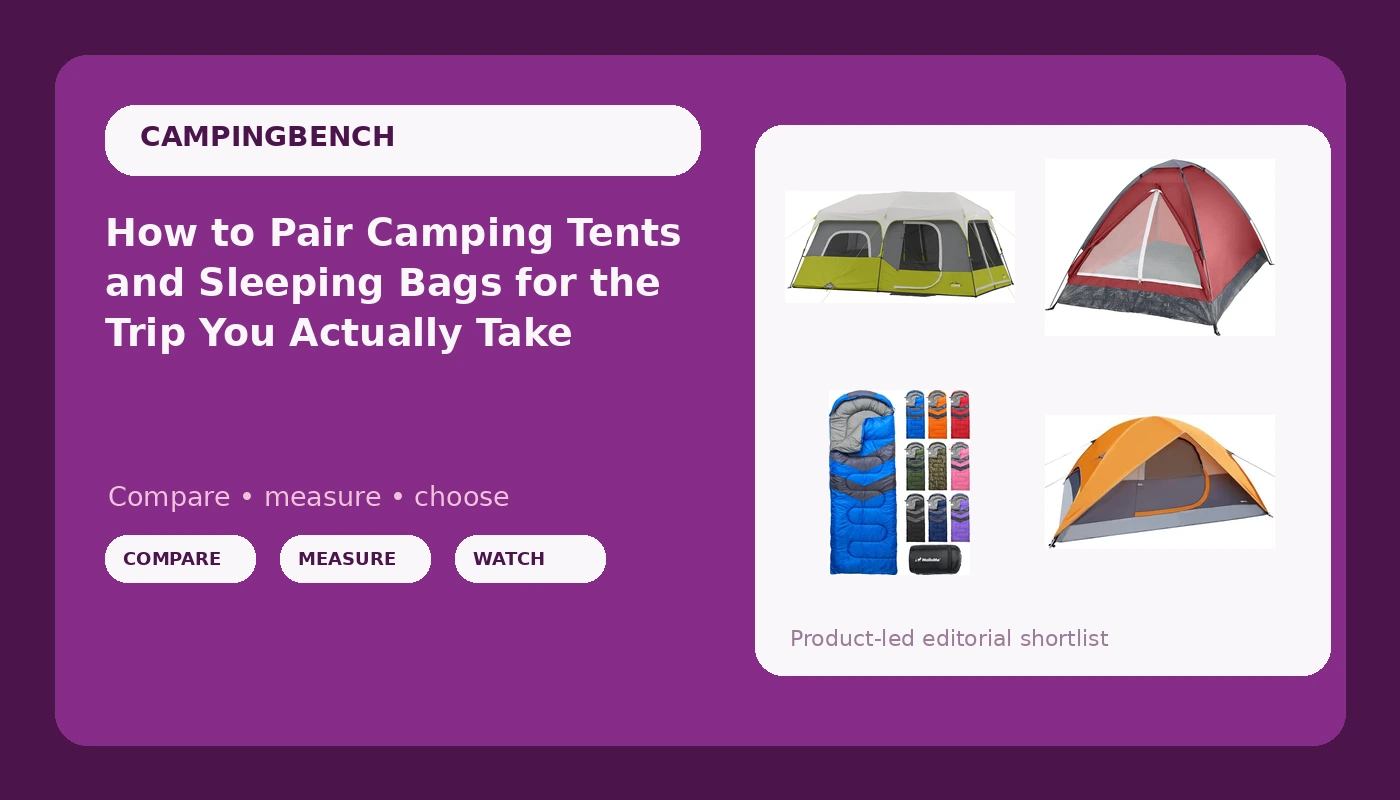
Most gear mismatches start at the store, not on the trail. Someone buys a nine-person cabin tent because the photos look like a living room, then finds out it only fits in a car trunk. Someone else grabs a bag advertised for cold weather, sleeps in it in July, and wakes up sweating at 2 a.m. Camping tents and sleeping bags are not two separate purchases. They are one shelter-and-sleep system, and the system has to match the trip: how many people are coming, how far you are carrying the load, and what the weather does after dark.
That is the problem this guide solves. You do not need the fanciest gear. You need a shelter that fits your arrival method and a sleep layer that matches the low temperature you will actually see.
Related: Tent Pitch Time and Why It Matters in a Storm →
Quick answer
Match the shelter to how you arrive, and the bag to how cold you sleep. If you drive to the site and sleep several people, a large instant cabin tent paired with a roomy rectangular sleeping bag covers the night with space to spare. If you walk in, a small dome or pop-up shelter with a lightweight bag keeps the load manageable. Capacity numbers on a tent box describe sleeping space, not comfort. Sleeping bag temperature wording describes a limit more often than a comfort level. Treat both as starting points, then adjust for your own body and the forecast.
Four useful options
| Model | Best fit | What stands out |
|---|---|---|
| Core 9 Person Instant Cabin Tent - 14' x 9', Green (40008) | Car camping with a group or family | Instant cabin layout, a 14 by 9 foot footprint, and a nine person capacity rating |
| 2 Person Camping Tent with Rain Fly and Carrying Bag, Lightweight Outdoor Pop Up Tents for Camping Essentials, Music Festivals, Backpacking, Hiking, or Beach Shelter by Wakeman Outdoors | One or two people who want a fast shelter | Pop up design, rain fly, and a carrying bag included |
| MalloMe Sleeping Bags for Adults Cold Weather & Warm - Backpacking Camping Sleeping Bag for Kids, Girls, Boys - Lightweight Camping Essentials Gear Accessories Hiking Sleep Must Haves Single & Double | The sleep layer for warm and cool nights | Offered in single and double versions with cold weather and warm weather wording |
| Amazon Basics Camping Tent, 3-Season Dome Design with Rainfly | General three season camping | Dome shape with a rainfly and three season intent |
The group basecamp: Core 9 Person Instant Cabin Tent - 14' x 9', Green (40008)
Cabin tents are the honest answer for a certain kind of trip. The near vertical walls mean adults can stand or kneel without folding themselves in half, and the rectangular floor lets cots and air mattresses sit side by side instead of overlapping. The trade is weight and packed size. A tent with this much floor area is a car camping tent, and treating it as anything else leads to a bad afternoon on a trail.
Instant style designs generally use pre-attached pole assemblies that unfold into place, which shortens setup considerably compared with threading separate poles through sleeves. The thing to watch is that the same frame that goes up quickly can be awkward to fold back down in wind, so practice the takedown at home at least once before a trip. Also plan for airflow. Large cabin tents have a lot of interior volume, and on a warm night that volume holds heat, so open the vents you have and position the door away from the morning sun. If you expect real rain, seam sealing and a properly staked rainfly matter more than any label on the box, and the footprint under a tent this size should be sized to match rather than improvised from a tarp that puddles at the edges.
The packable quick pitch: 2 Person Camping Tent with Rain Fly and Carrying Bag, Lightweight Outdoor Pop Up Tents for Camping Essentials, Music Festivals, Backpacking, Hiking, or Beach Shelter by Wakeman Outdoors
Pop up shelters are the trade in the other direction. You give up standing room and interior volume, and in exchange you get a small packed package and a setup that takes seconds rather than minutes. For a single overnight, a festival weekend, or a beach day where you want shade and a wind break, that trade makes sense.
Two things decide whether this kind of tent works for you. First, how it behaves once it is up. A pop up frame holds its shape on its own, which is convenient until wind arrives, so stake it out and use the guy lines rather than trusting the spring tension. Second, how it packs back down. Folding a pop up tent back into its bag has a technique, and it is worth learning on a lawn instead of in a parking lot at dusk. The included rain fly is what turns this from a fair weather shelter into something you can leave up through a shower, but a rain fly only covers the top, so keep gear off the walls and use the bag for anything that cannot get damp. As with any tent, seam sealing the fly and the floor corners before the first wet trip is cheap insurance.
The sleep layer: MalloMe Sleeping Bags for Adults Cold Weather & Warm - Backpacking Camping Sleeping Bag for Kids, Girls, Boys - Lightweight Camping Essentials Gear Accessories Hiking Sleep Must Haves Single & Double
A sleeping bag is only half of a sleep system. The other half is what is underneath you, because the bag's insulation compresses flat under your body weight and stops doing much of anything. That is why a closed cell foam pad or an insulated air pad changes a night far more than upgrading a bag does. Buy the bag, then buy a pad.
The single and double options matter more than they look. A double bag suits couples and lets two people share warmth, but it also needs a wider pad underneath and it packs larger. A single bag is easier to carry and easier to match to one person's comfort. When you read temperature wording, remember that it is not a promise about the night you will have. Sleep quality depends on your metabolism, what you wore to bed, whether you ate before sleeping, and how much wind is hitting the tent. Treat a rating as a rough boundary, add a liner or a warm base layer for shoulder season trips, and store the bag uncompressed between trips so the insulation keeps its loft.
The everyday dome: Amazon Basics Camping Tent, 3-Season Dome Design with Rainfly
The dome remains the default tent shape for a reason. It sheds wind and rain from most directions, it needs fewer stakes than a cabin, and the geometry is stable without being complicated. A three season designation means the tent is intended for spring, summer, and fall conditions rather than deep winter snow loading, which covers most camping people actually do.
Where a dome asks something of you is interior space. Sloped walls mean less headroom at the edges, so sleeping pads end up in the middle and packs end up near the door. That is fine for two people who packed light and annoying for two people who brought a cooler. The rainfly on this configuration is the part that determines how the tent handles weather, so pitch it fully, stake the fly out taut, and leave a gap between the fly and the tent body for air movement. Condensation on the inside of the walls is normal on a cold, still night, and the fix is ventilation, not a thicker tent.
Prices and availability may change. Product images, names, and retailer links must be matched by verified ASIN. Do not state a current price, rating, stock status, or measured result without current evidence.
How tent capacity ratings actually work
A capacity number on a tent box is a count of sleeping positions on the floor, not a measure of comfort. Manufacturers generally assume adults lying shoulder to shoulder on pads, with no gear inside. In practice, a tent rated for nine sleeps a family of five plus duffels comfortably, and a tent rated for two is a snug fit for two adults who each brought a pack.
Use capacity as a floor plan and then subtract. Deduct one person for every large dog. Deduct space for a cooler if the tent will hold one. Deduct again if anyone in the group is tall, because sleeping diagonally eats the width of a rectangular floor fast. The number that matters is not the rating, it is how many pads you can lay side by side without overlapping, and you can work that out from the listed floor dimensions before you buy.
Matching a sleeping bag to the night you expect
Temperature wording on a sleeping bag is one of the least standardized numbers in camping gear. Some brands describe a comfort threshold, some describe a limit where a cold sleeper is miserable but safe, and some describe an extreme that has little to do with a good night. Two bags with identical wording on the packaging can perform very differently in the same weather.
The practical approach is to look at the forecast low, then add margin. If the overnight low is expected to be 50 degrees, a bag described for warm weather with a decent pad is plenty. If the low is forecast near freezing, you want insulation, a pad with real insulating value, and a warm layer to sleep in. Sleeping cold is almost always a ground insulation problem before it is a bag problem, which is why the pad is not optional.
- Decide how you arrive at the site: car, trailhead, or a short walk from parking.
- Count actual sleepers and add space for the gear that comes inside.
- Write down the forecast low for the coldest night of the trip, not the average.
- Choose a shelter whose packed size matches how far you carry it.
- Choose a pad first, then a bag whose warmth wording sits above your expected low.
Field habits that save a trip
- Pitch the tent once at home before the trip, including the takedown, so nothing is new at camp.
- Seal the seams and check the rainfly before the first wet forecast, not during it.
- Stake every corner and guy line out; a taut tent sheds wind and a loose one flaps and leaks.
- Keep gear off the tent walls in rain, because fabric contact wicks water inward.
- Store the sleeping bag loose and uncompressed, and let the tent dry fully before packing it away.
Which option should you choose?
Choose the Core 9 Person Instant Cabin Tent - 14' x 9', Green (40008) when you drive to the site, sleep a group or a family, and want standing room and space for cots. Choose the 2 Person Camping Tent with Rain Fly and Carrying Bag, Lightweight Outdoor Pop Up Tents for Camping Essentials, Music Festivals, Backpacking, Hiking, or Beach Shelter by Wakeman Outdoors when one or two people want a small shelter that goes up in seconds and packs away easily. Choose the MalloMe Sleeping Bags for Adults Cold Weather & Warm - Backpacking Camping Sleeping Bag for Kids, Girls, Boys - Lightweight Camping Essentials Gear Accessories Hiking Sleep Must Haves Single & Double when you need the sleep layer itself, in a single for solo trips or a double for sharing. Choose the Amazon Basics Camping Tent, 3-Season Dome Design with Rainfly when you want a conventional three season dome for general camping.
The caveat is that none of these choices replace the pad underneath you, the seam sealing you do yourself, or a look at the actual forecast. A shelter and a bag are the two visible parts of a sleep system, but the ground insulation and the weather you prepared for decide how the night goes.
The bottom line
Pair the shelter with your arrival method and the bag with your expected low temperature. A cabin tent belongs on a car camping trip with several people, a pop up or dome belongs on trips where the load has to stay small, and a sleeping bag only performs as well as the pad beneath it. Read capacity ratings as floor space, read temperature wording as a boundary rather than a promise, and test the setup once before it counts. That is the whole decision, and it is easier to get right before you are standing in the rain at a trailhead.