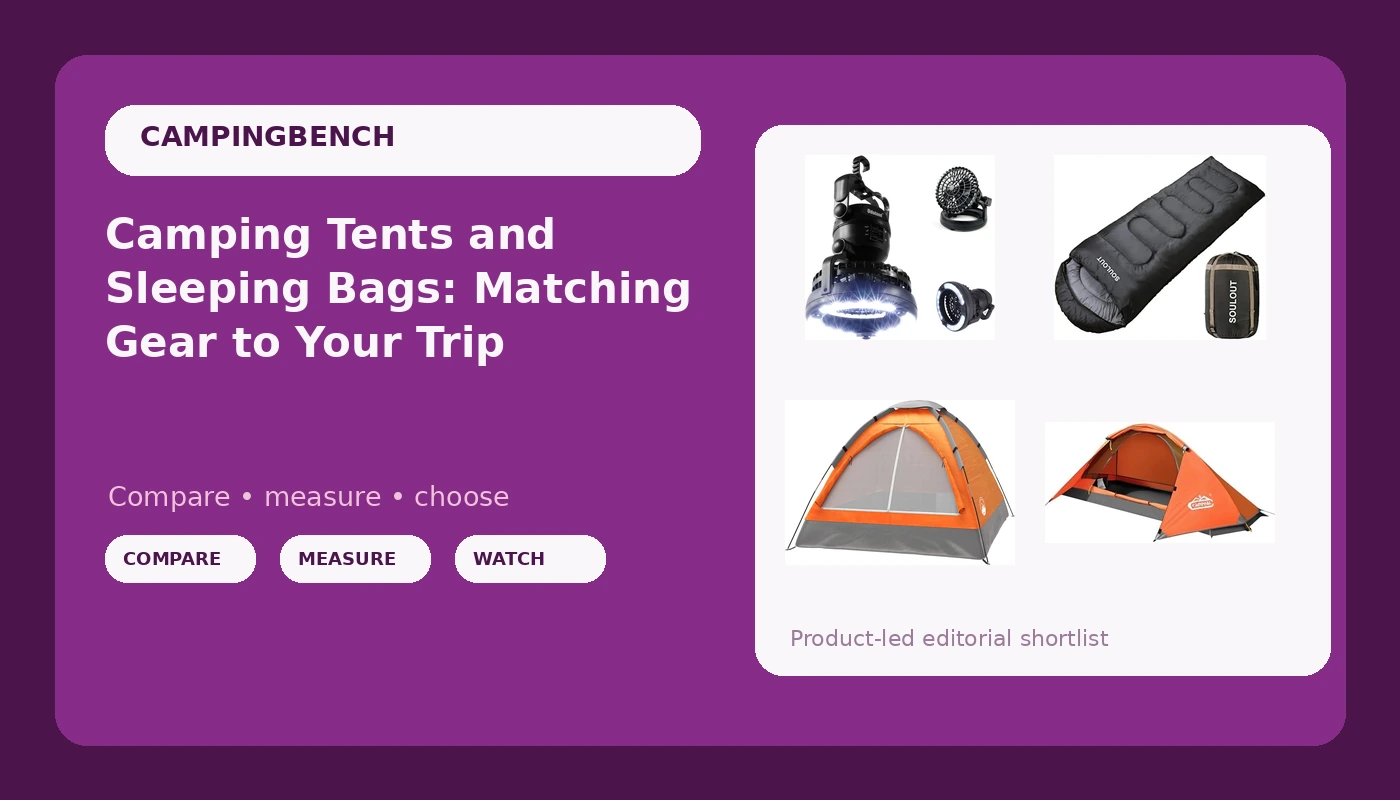
Most camping kits are not built. They accumulate. A tent bought for a festival, a sleeping bag inherited from a cousin, a lantern that was on sale in October. Each piece works fine on its own, and the combination still leaves you cold at 3 a.m. because nothing was chosen with anything else in mind.
Camping tents and sleeping bags are the two decisions that set everything else. They decide how far you can walk, how cold a night you can handle, and how much room the rest of your gear gets. Get those two right and the lighting, the stakes, and the cook kit mostly sort themselves out.
Related: How to Choose a Three-Season Backpacking Tent →
Quick answer
Match the shelter to the carry, and the bag to the cold. If you drive to your campsite, a roomy two-person tent with a rain fly is the practical pick, because packed weight barely matters and floor space does. If you walk in, a one-person tent you can pitch alone in bad weather matters more than elbow room. Choose the sleeping bag for the coldest night you realistically expect rather than the average one, and treat lighting and airflow as the last decision, not the first.
No single setup wins everywhere. The four products below cover four different jobs, and which one fits depends on your trip rather than on a ranking.
Four useful options
| Model | Best fit | What stands out |
|---|---|---|
| 2 Person Camping Tent with Rain Fly and Carrying Bag by Wakeman Outdoors | Car camping, festivals, beach days, short walks | Two-person pop-up design that includes a rain fly and its own carrying bag |
| camppal 1 Person Tent | Solo backpacking, hiking, hunting, mountain trips | One-person four-season design described as windproof, rainproof, and waterproof |
| Odoland Portable LED Camping Lantern with Ceiling Fan | Lighting and airflow inside a tent or small room | Lantern and ceiling fan combined in one portable unit, sold for camping and hurricane emergencies |
| SOULOUT 3-4 Season Sleeping Bag | Three-season sleep for adults and teens | A 3-4 season bag sized for adults and teens |
The car camping shelter: 2 Person Camping Tent with Rain Fly and Carrying Bag by Wakeman Outdoors
The case for a tent like this is simple: it removes the two most common reasons people sleep badly at a campground. It has room for two, so you are not fighting a bag and a pack for space, and it comes with a rain fly, so an overnight shower does not turn into a wet sleeping bag. The carrying bag means it travels in the trunk without shedding stakes across the floor.
The trade-off runs in the other direction. Tents in this class tend to prioritize interior space and easy pitching over packed size, which is exactly what you want when the vehicle is carrying the load and a poor match when you have ten miles to walk. Buy it for the campsite you drive to, not the one you hike to.
The solo shelter: camppal 1 Person Tent for Camping Hiking Mountain Hunting Backpacking
A solo tent is a different animal. You are the only person available to hold the poles, so pitch sequence matters more than floor area, and the packed size is a number you feel at mile eight. A one-person, four-season design is built for the version of camping where weather is not a hypothetical.
Two honest caveats. Four-season shelters generally trade ventilation for weather protection, so condensation on a still, humid night is a real possibility, and a single-wall night in a wet climate gets damp. And one-person means one person: your pack lives in the vestibule or it lives with you. If you want to sit up and spread out, this is the wrong shape of tent.
The light and airflow pick: Odoland Portable LED Camping Lantern with Ceiling Fan
This is the piece people forget and then miss. A sealed tent on a warm, windless night becomes a small greenhouse, and moving air is the cheapest comfort upgrade available. Hanging a fan from the ceiling loop does more for sleep quality than a thicker bag does in July. The light matters too: a tent lantern keeps your headlamp free for the walk to the water tap.
Treat it as a comfort accessory, not a climate control system. A fan moves air; it does not cool a tent. If the forecast is genuinely hot, you still want shade, a lower elevation, or a site with a breeze.
The sleep system: SOULOUT 3-4 Season Sleeping Bag for Adults & Teens
A bag rated for three to four seasons is the middle of the market: warmer than a summer bag, less specialized than a deep-winter one, and versatile enough that it covers most of the nights a typical camper actually spends outside. If you camp from spring through fall in a temperate climate, this is the band you want to shop in.
The part most people get wrong is the pad underneath. A sleeping bag insulates what is above you and compresses flat under your body weight, so the cold comes up through the ground. Budget for a pad with a real insulation rating before you spend the difference on a warmer bag.
Prices and availability may change. Product images, names, and retailer links must be matched by verified ASIN. Do not state a current price, rating, stock status, or measured result without current evidence.
Why carry distance decides the tent
The single most useful question about a tent is not how many people it sleeps. It is whether you are carrying it. A shelter that lives in a car has different obligations than one that lives on your back. In the car, the constraints are floor space, headroom, and how quickly you can set it up in the dark after a long drive. On your back, the constraints are packed size, base weight, and whether one person can pitch it alone in wind.
That is why the same camper can reasonably own both a two-person pop-up and a one-person backpacking tent. They are not competing answers to the same question. One is for the site with a parking spot, the other is for the site at the end of a trail.
Pitch time deserves more weight than it usually gets. A tent that takes twenty minutes to assemble is a tent you will put up badly in the rain, or skip entirely and regret. Practice at home, in daylight, before the trip where it counts. Seam sealing is the other thing to think about: factory treatments age, and a seam that has stopped doing its job will find the one night you needed it.
Sleeping bag ratings, pads, and cold ground
A temperature number on a sleeping bag is an estimate of comfort, not a guarantee, and comfort varies by person. Sleep cold, and you should shop one band warmer than the number suggests. Sleep warm, and you can get away with less.
Three variables decide how warm you actually sleep. The bag is one. The pad is the second, and it is the one people skip. The third is what you wear and eat before bed: a dry base layer and a hot meal do more than most gear upgrades.
The pad matters because of how insulation works. Loft in a bag traps air, and your body weight crushes that loft flat beneath you. What is left between you and the ground is the pad, which is why pads carry their own insulation rating. A cheap foam pad under a good bag beats a good bag on bare ground every time.
A five-step way to build a setup
- Write down the coldest night you realistically expect on the trips you actually take, not the trips you imagine taking.
- Decide whether the car or your back is carrying the shelter.
- Pick the tent first, matching it to that carry distance and to how much weather you are willing to camp in.
- Pick the sleep system second: bag for the temperature, pad for the ground.
- Add lighting and airflow last, because they are comfort items you can improvise if the budget runs out.
Field habits that keep a simple setup working
- Pitch the tent at home once before the trip, in daylight, with the stakes you plan to bring.
- Check that the rain fly covers the seams and that nothing is pinched between the fly and the body.
- Air and dry the sleeping bag fully after every trip, and store it loose rather than compressed.
- Bring a groundsheet or footprint, even a cheap one, to protect the floor from abrasion.
- Test the lantern and fan on the batteries you plan to use, and pack spares.
- Keep a small repair kit: a patch, a spare stake or two, and a length of cord.
Which option should you choose?
Choose the 2 Person Camping Tent with Rain Fly and Carrying Bag by Wakeman Outdoors when you drive to the site and want space, a rain fly, and simple pitching for two people. Choose the camppal 1 Person Tent when you are carrying your shelter on your back and want a small, weather-resistant solo design. Choose the Odoland Portable LED Camping Lantern with Ceiling Fan when you want light and moving air in a sealed tent or during a power outage. Choose the SOULOUT 3-4 Season Sleeping Bag when you camp across spring, summer, and fall in a temperate climate and want one bag that covers the range.
None of these are mutually exclusive. A car camper who also backpacks will eventually own a shelter for each, and a lantern plus a bag is a reasonable starting pair for anyone building a kit from nothing.
This guide describes products from their listings and general camping practice. It does not rank them against one another, and no current price, rating, or measured performance figure is stated here, so check the current listing before you buy.
The bottom line
Build the kit around the two decisions that are hardest to fix later: shelter and sleep. Match the tent to how the gear travels, match the bag to the coldest night you will actually see, and put a real pad under it. Lighting and airflow come last, and the right answer there is usually the simplest one. The goal is not the most gear. It is the setup you will still be happy to carry, and happy to sleep in, on night three of a trip.