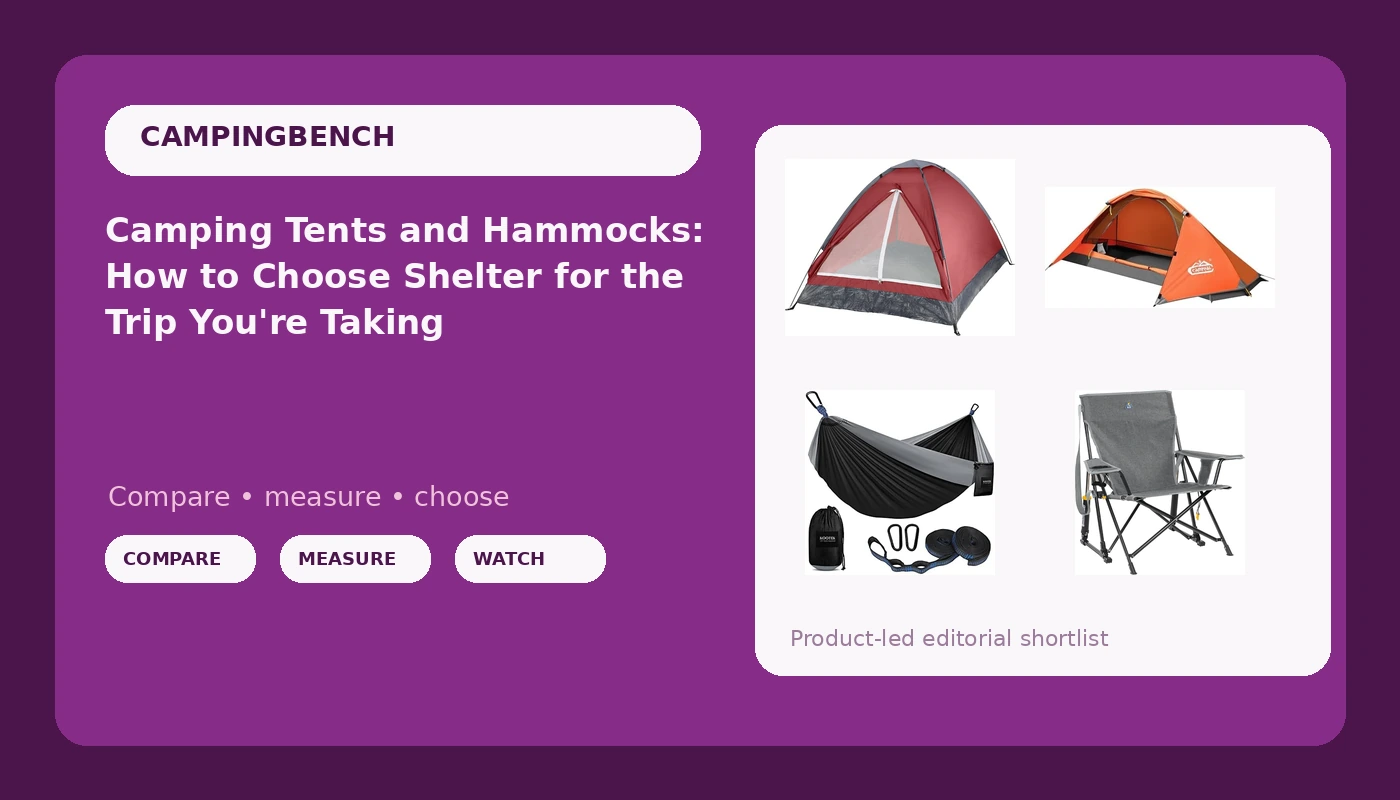
Shopping for camping tents and hammocks is easy. Choosing between them is where people get stuck. Every listing promises waterproof fabric, fast setup, and a weight that sounds fine on a screen. None of them tell you what the shelter is like at 2 a.m. when the wind shifts and the rain starts coming in sideways.
I spent six seasons as a park ranger and one full thru-hike of the Pacific Crest Trail, and I have slept in tents for more than 500 nights. The lesson that stuck is that shelter is a trade-off, not a ranking. A two-person pop-up tent, a solo four-season tent, a hammock, and a camp chair are not competing for the same job. They solve four different problems: sleeping two people cheaply, sleeping one person in weather that refuses to cooperate, sleeping off the ground, and having somewhere comfortable to sit once camp is up.
This is an explainer, not a leaderboard. Below are four currently listed options, what each one is built to do, and how to decide which belongs in your car or on your back.
Related: How to Read Tent Season Ratings and Waterproof Claims →
Quick answer
Match the shelter to the trip, not to the marketing. Camping from a car, a festival lot, or a beach? A two-person tent with a rain fly covers two sleepers and asks the least of your budget. Carrying your shelter on your back into cold or exposed terrain? A one-person four-season tent is the more defensible choice, because a solo shelter is easier to pitch, easier to warm, and easier to carry. Sleeping where trees are reliable and the ground is wet or uneven? A double hammock rated to 500 lbs gets you off the soil. Sitting around a fire at the end of the day? A rocking camp chair is the piece of gear people actually use every evening. Weight, season rating, and pitch time decide the rest.
Four useful options
| Model | Best fit | What stands out |
|---|---|---|
| 2 Person Camping Tent with Rain Fly and Carrying Bag, Lightweight Outdoor Pop Up Tents for Camping Essentials, Music Festivals, Backpacking, Hiking, or Beach Shelter by Wakeman Outdoors | Car camping, festival weekends, beach days | Two-person capacity with a rain fly and carrying bag included |
| camppal 1 Person Tent for Camping Hiking Mountain Hunting Backpacking Tents 4 Season Resistance to Windproof Rainproof and Waterproof | Solo trips in cold or shoulder-season weather | One-person, four-season listing with wind and rain resistance claims |
| Kootek Camping Hammock 500lbs Capacity Outdoor Camping Essentials, Double | Camping where trees are reliable | Double hammock with a 500 lb capacity rating |
| GCI Outdoor Kickback Rocker Outdoor Rocking Chair with Beverage Holder | Sitting at camp after the hiking stops | Rocking frame with a built-in beverage holder |
Two-person shelter: 2 Person Camping Tent with Rain Fly and Carrying Bag, Lightweight Outdoor Pop Up Tents for Camping Essentials, Music Festivals, Backpacking, Hiking, or Beach Shelter by Wakeman Outdoors
A two-person tent is the default answer for any trip where the vehicle stays close, and this one leans into that role. The rain fly is the part that matters most, because a fly is what keeps rain off the body of the tent and away from the door. Two-person capacity means two sleeping bodies, not two adults plus two packs plus a cooler; treat the floor space as sleeping space and leave the gear in the vestibule or the car. Factory waterproofing is a promise with an expiration date, so plan to seal the seams yourself before the first wet weekend. If you are considering this as a backpacking shelter, weigh the complete package at home first: tent, poles, stakes, fly, and bag together.
Solo shelter: camppal 1 Person Tent for Camping Hiking Mountain Hunting Backpacking Tents 4 Season Resistance to Windproof Rainproof and Waterproof
One-person tents are about commitment. You give up room and you get back weight, warmth, and pitch speed, and all three of those matter more than people expect. A four-season label generally signals less mesh, more structure, and fabric built for weather, which is why those tents are heavier than summer shelters. It does not mean the tent keeps you warm; warmth comes from your sleeping pad and bag. Wind resistance is a structural question, so look at pole count and profile rather than the word "windproof." A solo shelter also pitches faster with cold hands, which is the difference between setting up before the rain and setting up in it.
The hammock option: Kootek Camping Hammock 500lbs Capacity Outdoor Camping Essentials, Double
A hammock trades ground for trees, and the trade is generous when the trees cooperate. You need two solid trunks roughly 12 to 15 feet apart, and you need to be below treeline, which rules hammocks out for alpine and desert trips. The part that surprises new hammock campers is insulation: your sleeping bag compresses underneath you and stops insulating, so you need an underquilt or a pad in the hammock. Wide tree straps are the Leave No Trace standard, because rope and thin cord cut into bark. Side sleepers and stomach sleepers should spend a night in a hammock before committing to one for a full trip.
The camp chair: GCI Outdoor Kickback Rocker Outdoor Rocking Chair with Beverage Holder
Comfort is the trade-off people forget to budget for, and a chair is the item that changes how a trip feels at hour nine. Sitting on the ground works until it doesn't, and a chair with a rocking frame keeps you upright and moving instead of slumped against a cooler. This is not a backpacking item and it is not pretending to be. For car camping, festival weekends, and basecamp trips where the vehicle is the anchor, it earns the space it takes up. If you are carrying everything on your back, leave it home and sit on a pad.
Prices and availability may change. Product images, names, and retailer links are matched to verified listings. No current price, rating, stock status, or measured result is stated here without current evidence.
What season ratings and waterproof claims actually mean
Season ratings describe intent, not performance. A three-season tent assumes mild nights and occasional rain. A four-season tent assumes snow load, sustained wind, and cold, which is why it usually carries more poles, less mesh, and more fabric weight. Neither label tells you how warm you will sleep. Your pad and bag do that, and a four-season tent with a summer bag is still a cold night.
Waterproof is the most abused word in camping gear. What actually matters is coated fabric, sealed or taped seams, and a rain fly that covers the doors instead of just the roof. Factory seam sealing dries out and fails, so re-seal seams with a seam sealer before a wet trip. If a listing says waterproof and you never seal it, you own the leak.
Capacity numbers are sleeping bodies. A two-person tent sleeps two people who are comfortable being close and are not storing much inside. For two adults and their gear, look at three-person. For one person and a pack, a one-person tent is enough, though a two-person gives you room to dress and sort gear out of the rain.
Pitch time is a safety feature. A tent that takes twenty minutes in a driveway takes longer in wind, rain, and cold hands. Practice once at home, in daylight, before the trip that matters.
Hammocks need three things beyond the hammock itself: trees, insulation underneath, and a suspension that does not damage bark. Chairs need one decision: does the chair live in the trunk or in the pack? Most people carry exactly one, and it is almost always the car version.
A five-step way to choose
- Name the trip in one sentence, including how you get there. "Two nights at a drive-in site during a festival" and "three days solo above treeline" are different purchases.
- Decide whether you carry the shelter. If yes, weigh the complete package: shelter, poles, stakes, fly, and bag. If that number is not something you would want at mile 12 on day three, it is car gear, and that is a fine answer.
- Match the shelter type to the terrain. Trees and soft ground point toward a hammock. Exposed, rocky, sandy, or treeless ground points toward a tent.
- Check the weather envelope. Look for full-coverage rain flies, seams you can re-seal, and a season rating that matches the coldest night you expect, not the warmest.
- Audit the rest of the system. A shelter is one piece. Your pad and bag decide whether you sleep warm, and your chair decides whether the evening is comfortable.
What to check before you buy
- Read capacity as a sleeping capacity, not a comfort capacity.
- Confirm the rain fly covers the door and not just the roof.
- Plan to seam seal a new tent before its first wet night, even when the listing says waterproof.
- Check what ships in the box, because poles, stakes, guylines, and a carrying bag are sometimes sold separately.
- For hammocks, budget for straps and under-insulation; the hammock alone is not a sleep system.
- For chairs, accept the weight trade and decide up front whether it lives in the trunk.
Which option should you choose?
Choose the 2 Person Camping Tent with Rain Fly and Carrying Bag by Wakeman Outdoors when you camp from a car, a festival lot, or a beach and want one shelter for two sleepers with a rain fly included. Choose the camppal 1 Person Tent when you are carrying your shelter solo into cold or exposed conditions and want a dedicated one-person, four-season design. Choose the Kootek Camping Hammock when trees are reliable, the ground is wet or uneven, and you want to sleep off the soil. Choose the GCI Outdoor Kickback Rocker when the trip includes long evenings at camp and the chair can live in the car or a short walk from it.
One caveat before you buy: the details above come from the product listings, not from a field trial I ran on these four units. I have not measured packed weight, pitch time, or storm performance for them, and this site does not publish a rating, a price, or a test result it cannot currently verify. Treat season, waterproof, and capacity language as manufacturer claims. Pitch any new shelter on a fair-weather night before you trust it on a bad one.
The bottom line
The shelter decision comes down to one question: are you carrying it? If the answer is no, a two-person tent with a rain fly and a rocking chair with a beverage holder turn a drive-in site into a comfortable basecamp, and a double hammock gives you a third option when the ground is bad. If the answer is yes, the math flips, because every ounce has to earn its place, and a one-person four-season tent or a hammock with the right insulation is how you keep the load honest. Weight is not a number on a spec sheet. It is how you feel at mile 12 on day three. Pick the shelter that matches the trip you are actually taking, seal the seams before the rain finds them, and put the money you saved into a better sleeping pad.