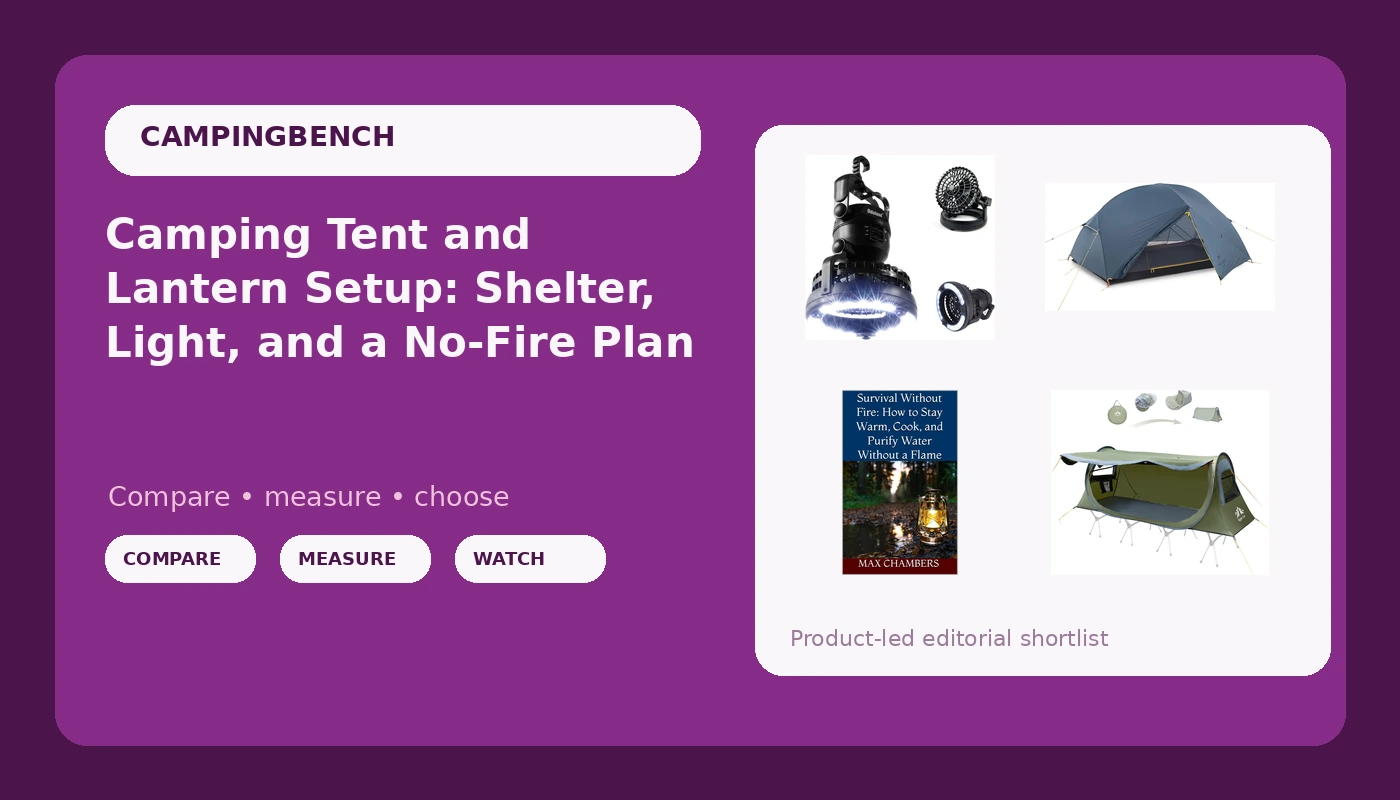
A camp setup is really three problems wearing one jacket: where you sleep, what you can see and breathe after dark, and what you do when the usual answers stop working. Most people solve the first one and improvise the rest, which is how a trip ends early with a soaked sleeping bag, a dead light, or a cold dinner nobody planned for. A camping tent and lantern setup that holds together covers all three.
The four pieces below are not a matched set from a single brand. They are four roles a small camp needs filled: a two-person shelter you can carry on your back, a one-person shelter you can throw up in a hurry, a light that also moves air, and a reference for the nights when you cannot light a fire at all. What follows is what each one does, where each one stops being the right answer, and how to decide which of them belongs in your pack.
Related: How to Read a Tent Spec Sheet Without Getting Fooled →
Quick answer
For most backpackers, the Naturehike Mongar 2 Person Backpacking Tent is the shelter to build a trip around: three-season, double-layer, free-standing, and sized for two. The Night Cat Pop-up Camping Tent fits the solo camper who wants setup finished in one motion and sleeps on a cot. The Odoland Portable LED Camping Lantern with Ceiling Fan covers light and airflow from a single hanging unit. Survival Without Fire covers the scenario the other three cannot: staying warm, cooking, and purifying water with no flame at all.
Four useful options
| Model | Best fit | What stands out |
|---|---|---|
| Naturehike Mongar 2 Person Backpacking Tent | Two people sleeping on the move | Three-season, double-layer, free-standing design listed for camping, hiking, and cycling |
| Night Cat Pop-up Camping Tent | One person on a cot, quick stops | Pop-up tunnel design listed as instant and easy to set up, sized for a camping cot sold separately |
| Odoland Portable LED Camping Lantern with Ceiling Fan | Light and moving air inside a tent | Lantern and ceiling fan combined in one portable unit, positioned for camping and emergency use |
| Survival Without Fire | Trip planning for no-flame conditions | Covers staying warm, cooking, and purifying water without fire |
The two-person shelter: Naturehike Mongar 2 Person Backpacking Tent
The trade-off here is the one every backpacking tent makes. A double-wall, free-standing shelter gives you more usable interior space and a structure that stands up before it is staked, and it costs you weight and packed volume compared with a single-wall trekking-pole design. The word "ultralight" on a listing is a claim, not a measurement. Before you commit, look up the packed weight of the whole package, tent body, fly, poles, stakes, and stuff sacks, and compare that number to the base weight you are actually willing to carry. A shelter that gets left in the garage because it feels heavy at the trailhead is not saving you anything.
Pitch time matters more than most people admit. A tent you can set up in a predictable sequence in wind and rain is a tent you will actually use, and one that requires threading poles from the inside is a tent you will be miserable in during the first storm of the season. Practice the sequence once at home in daylight before you need it in the dark.
The one-person instant option: Night Cat Pop-up Camping Tent
Pop-up shelters trade packed shape for setup speed. The folded frame is a wide disc rather than a long bundle, so it can be awkward in a backpack and much easier to live with when the tent travels in a vehicle. If your trips start from a trailhead parking lot and end at a cot, that trade is a good one. If you are counting grams for a multi-day route, it usually is not.
Waterproof is a promise with an expiration date. The coating on a tent floor and fly degrades with UV exposure, abrasion, and storage in a hot car, and seams are where water finds its way in first. Check the seams on any tent you plan to sleep in during real rain, and re-treat them when they start wicking. A cot also changes how you use the space: it lifts you off the ground, which helps in cold or damp conditions, but it means the tent has to be tall enough and long enough to fit the cot plus you.
The light and airflow piece: Odoland Portable LED Camping Lantern with Ceiling Fan
Condensation is the quiet failure mode of tent camping. You exhale water vapor all night, it condenses on the coolest surface it can find, and by morning your sleeping bag footbox is damp. Ventilation is the fix, and moving air across the interior helps a double-wall tent do its job. A hanging fan moves that air without taking floor space, and the same unit gives you light for sorting gear after dark. The thing to plan for is power: any lantern and fan combination is only useful as long as it has a charge, so treat it as one more item on the battery list and carry a backup headlamp for walking.
The no-flame plan: Survival Without Fire
In the Pacific Northwest, fire bans are not an edge case. They arrive in August with dry fuels, wind, and a red flag warning, and they close the door on the campfire and sometimes on the stove as well. The question a no-fire plan answers is simple: if you cannot light anything, how do you stay warm, eat, and get safe water? That is a different problem from building a fire in the rain, and it is the one worth reading about before the ban, not during it.
Prices and availability may change. Product images, names, and retailer links must be matched by verified ASIN. Do not state a current price, rating, stock status, or measured result without current evidence.
Why double-layer and free-standing designs matter
Single-wall tents are lighter and simpler, and they collect condensation on the inside of the fabric directly above your face. Double-wall tents put a separate inner body and a fly between you and the weather, which moves the condensation point away from your sleeping bag and gives you a fabric layer that can be vented. That is why a double-layer design like the Mongar 2 is the safer default for three-season camping, even though it weighs more.
Free-standing is the other half of the story. A free-standing tent holds its shape from the pole structure alone, so you can set it up on rock, in a shelter, or on a platform and then move it into position before staking it out. Tents that require staking to stand are lighter and can handle more wind once they are anchored, but they are harder to pitch in bad conditions and impossible on ground where stakes will not hold. Match the structure to the terrain you actually camp on.
What a no-fire plan changes about packing
Once you accept that some nights will not include a flame, three parts of your pack change. Water treatment becomes non-negotiable rather than a backup, because boiling is off the table. Food shifts toward things you can eat cold or warm with a chemical heat source. Warmth becomes a clothing and insulation problem, solved with layers and a sleeping pad's R-value rather than with radiant heat.
That last point is where most people underinvest. The ground pulls heat out of you all night, and a pad with an honest R-value does more for your comfort than any fire ever will. Read the R-value rating the same way you read a tent's weight claim: as a manufacturer number to verify against how you actually sleep.
- Start with how many people are sleeping, not with the tent you like the look of.
- Decide whether the shelter rides on your back or comes out of a vehicle, because that single answer eliminates half the options.
- Match the light to the job: overhead light and moving air for the sleeping hours, a handheld beam for walking and water trips.
- Check what your trip allows, including fire bans, stove restrictions, and where your water comes from, before you decide how much of a no-fire plan you need.
- Weigh the entire setup as one number, then compare it to the base weight you are genuinely willing to carry for the distance you planned.
Practical habits that keep a small setup working
- Pitch the tent once at home, in daylight, so the sequence is familiar before weather makes it urgent.
- Check and re-seal seams on any tent you expect to sleep in during rain, since factory treatment is a starting point rather than a permanent guarantee.
- Hang the lantern above head height so the fan moves air across the whole sleeping area instead of blowing into one person's face.
- Test your water treatment method and your cold-food options at home, because a no-fire plan you have never used is not a plan.
- Carry a small repair kit for stakes and pole sections, and know which components your shelter needs in order to stand at all.
Which option should you choose?
Choose the Naturehike Mongar 2 Person Backpacking Tent when two people are carrying the shelter and you want a three-season, double-layer, free-standing design for hiking and cycling trips. Choose the Night Cat Pop-up Camping Tent when you are camping solo, sleeping on a cot, and want setup to be a single motion at a drive-up site. Choose the Odoland Portable LED Camping Lantern with Ceiling Fan when you want overhead light and moving air in one unit, with hurricane and emergency backup in mind. Choose Survival Without Fire when your trips happen in fire-restricted country and you want a reference for warmth, cooking, and water purification without a flame.
One caveat worth stating plainly: the details above come from the manufacturer listings, not from measurements taken in the field. Packed weight, packed size, waterproofing performance, and battery life are all claims to verify against the current product page and against your own trip requirements before you buy. Treat any rating, including a temperature or R-value number, as a starting point for your own judgment rather than a promise.
The bottom line
A workable camp setup is not one perfect tent. It is shelter, light, airflow, and a plan for the nights when nothing will light. Start with the shelter that matches how you travel, add a light that also moves air, and read up on the no-fire case before a burn ban forces the issue. Then weigh the whole thing and be honest about whether you will carry it, because the best gear is always the gear that actually leaves the trailhead with you.