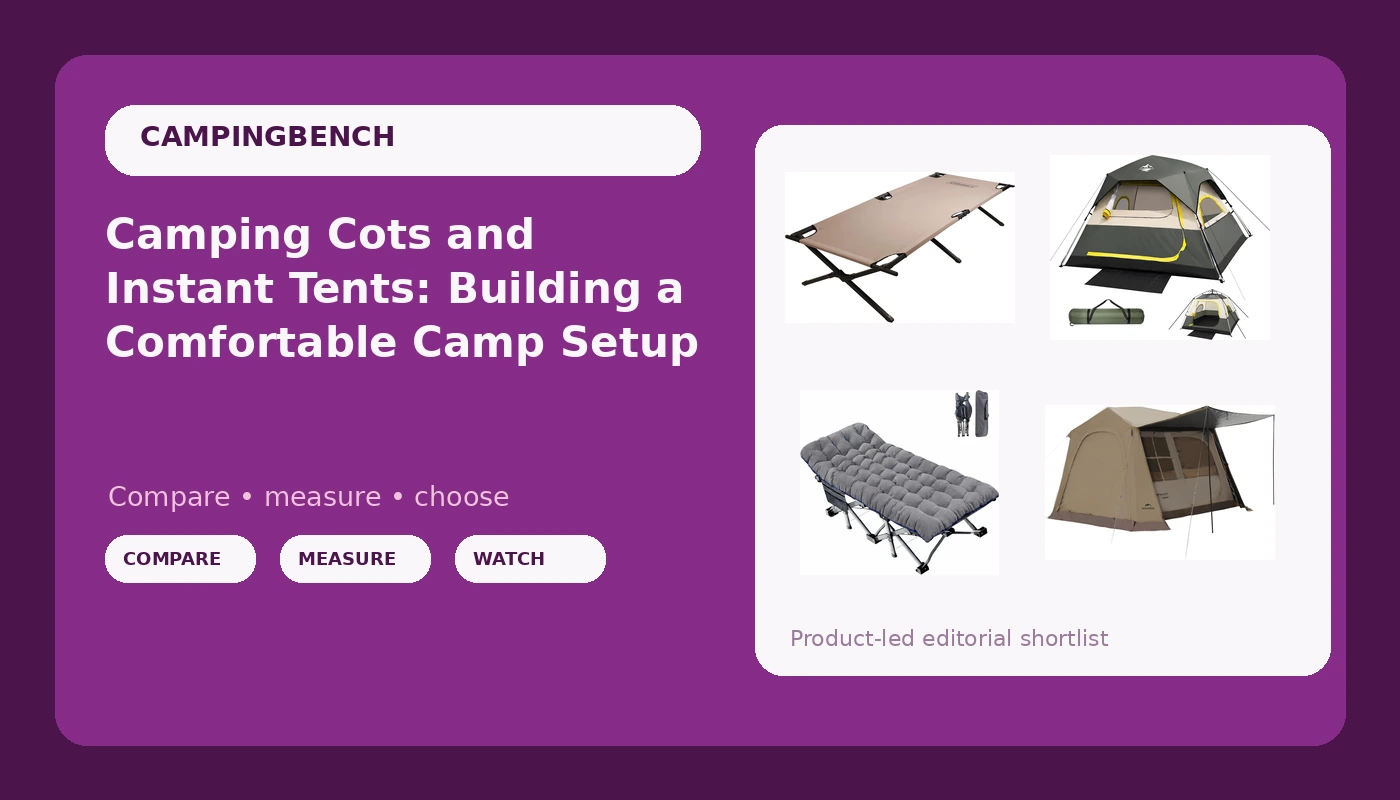
Two pieces of gear decide whether a car camping weekend feels like a hotel room or a wrestling match with the ground: the platform you sleep on and the shelter over your head. A camping cot and instant tent combination matters more than most gear purchases, because both items set up quickly, both eat real space in the vehicle, and both are the difference between waking up rested and waking up stiff at 4 a.m. listening to your own hip complain.
The four options below sit at opposite ends of two spectra. Two are folding cots: one oversized with a pad included, one a long-running folding design rated for adults up to 6 feet 2 inches. Two are instant tents: a budget four-person cabin and a premium model built around a full rainfly. None of them are backpacking gear. Every one of them is aimed at the trip where you park close, walk a short distance, and want camp standing before the coffee water boils. The trick is knowing which pairs with which.
Related: Pitch Time Explained: Why Setup Speed Changes a Camping Trip →
Quick answer
Match the cot to the sleeper and the tent to the weather you actually expect, in that order. The ABORON XXL is the oversized option here, listed at 78 by 32 inches with a mattress pad and a 900 pound rating. The Coleman Trailhead II is the classic folding cot, listed for adults up to 6 feet 2 inches or 300 pounds. The four-person instant cabin is the budget shelter with a rainfly over the roof. The Naturehike Village Instant Tent is the one that pairs an instant frame with full rainfly coverage, which is what you want if rain is likely rather than possible. Start with the cot, because a bad night of sleep ends a trip faster than a mediocre tent.
Four useful options
| Model | Best fit | What stands out |
|---|---|---|
| ABORON XXL Camping Cot for Adults, Oversized 78"×32" Folding Camping Bed, 900LBS Heavy Duty Outdoor Sleeping Cot with Mattress Pad, 1200D Oxford, Portable with Carry Bag | Adults who want a wide, elevated sleeping surface without adding a separate pad | Listed at 78 by 32 inches, rated to 900 pounds, 1200D Oxford fabric, mattress pad and carry bag included |
| 4 Person Instant Tents for Camping Setup in 50s, Cabin Tent with Rainfly | Car campers who need a roomy shelter for four at a modest outlay | Instant-pitch cabin design advertised as setup in 50 seconds, with a rainfly included |
| Naturehike Village Instant Tent, Camping Tent with Full Rainfly | Campers who plan around wet weather and want wall coverage, not just a roof | Instant-pitch frame paired with a full rainfly rather than a roof-only fly |
| Coleman Trailhead II Large Folding Cot with Easy Setup & Takedown, Supports Adults up to 6ft 2in or 300lbs, Great for Camping, Lounging, Elevated Sleeping, Guests, & More | Solo adults, overnight guests, and anyone who wants a simple folding cot | Folding frame with easy setup and takedown, listed for adults up to 6 feet 2 inches or 300 pounds |
The oversized platform: ABORON XXL Camping Cot for Adults, Oversized 78"×32" Folding Camping Bed, 900LBS Heavy Duty Outdoor Sleeping Cot with Mattress Pad, 1200D Oxford, Portable with Carry Bag
The number that matters most here is 78 inches of length, because that number reaches backward into your tent decision. A cot this long needs a tent with a floor long enough to hold it without jamming the door panel, and a cabin-style tent with near-vertical walls handles that geometry far better than a dome with sloped sides. The 32 inch width is the other half of the story: two of these side by side need 64 inches of floor, which pushes most buyers toward a four-person cabin rather than a two- or three-person dome. The trade-off is vehicle space. A cot that folds into a long bag takes up room a sleeping pad never would, and the pad included in the box is a thin one, so side sleepers should still plan on an extra layer.
The budget instant cabin: 4 Person Instant Tents for Camping Setup in 50s, Cabin Tent with Rainfly
Instant tents trade packed weight and bulk for pitch time, and that trade is worth making when the alternative is standing in the rain reading a pole diagram. The thing to understand about the rainfly on a tent in this class is that it covers the roof. That handles ordinary rain fine. It does less well in wind-driven rain, where water hits the tent walls directly, and it does nothing for the condensation that builds when four people breathe inside a sealed cabin on a cold night. If you camp mostly in summer and check the forecast, this is a sensible shelter. If your trips run into October in the Pacific Northwest, read the next section before you decide.
The weather-ready instant tent: Naturehike Village Instant Tent, Camping Tent with Full Rainfly
A full rainfly is the single most useful upgrade on a car camping tent, and it is the reason this one costs more than the cabin above. The fly creates a gap between the tent body and the outer layer, and that gap is where condensation and wind-driven rain get managed. It also gives you a dry-ish zone near the door for boots. The catch is that more fabric means more packed bulk and a longer dry-out at home, so a tent like this wants a garage or a clothesline after a wet trip, not a stuff sack in a closet. If you pitch it wet and store it wet, the waterproofing you paid for will not survive many seasons.
The classic folding cot: Coleman Trailhead II Large Folding Cot with Easy Setup & Takedown, Supports Adults up to 6ft 2in or 300lbs, Great for Camping, Lounging, Elevated Sleeping, Guests, & More
This is the cot most people picture when they hear the word cot: a flat deck on a folding frame, no pad in the box, and a design that has been copied by nearly everyone. Two things to plan for. First, there is no cushion, so pair it with a sleeping pad; the cot lifts you off cold ground and away from rocks, but it does not add warmth or softness on its own. Second, mind the stated height limit. At 6 feet 2 inches, taller sleepers should look at the oversized cot above instead of pushing past the rating. For guests, kids' rooms, and quick solo weekends, though, the simplicity is the whole appeal.
Prices and availability may change. Product images, names, and retailer links are matched to verified listings. No current price, rating, stock status, or measured result is stated here without current evidence.
Why the cot decides the tent
Most people shop for the tent first and then discover the cot does not fit. Reverse the order. Floor area is the constraint, and cots consume it in a way sleeping pads do not.
A cot listed at 78 by 32 inches occupies roughly 2,500 square inches of floor before you add a single duffel. Two of them side by side need more than 5,000 square inches of usable floor, and "usable" is the key word. Tent capacity ratings count sleepers lying shoulder to shoulder on the ground, not cots standing on legs with a frame that has to clear the door. A four-person cabin tent usually lists a floor around 8 feet by 8 feet, which sounds generous until you place two cots, two bags, and a cooler inside it.
Wall angle matters as much as floor size. A dome tent loses usable space as the walls curve inward, so a cot pushed against the side ends up partly under sloping fabric. Cabin tents with near-vertical walls keep that space usable, which is why cots and cabin tents pair so naturally.
Center height is the second number to check. You want to be able to sit up on the cot without your head pressing the ceiling, and you want enough room above your face to keep your breath away from cold fabric. That is a condensation issue, not just a comfort one. Sleeping elevated also means more air moves under you, which feels cooler on a cold night and much better on a hot one. Bring a pad with real insulation value for shoulder-season trips, because a cot frame does not insulate the way a foam pad on the ground does.
How to size a sleep system in five steps
- Measure the sleeper, not the gear. Height and weight decide the cot. Anyone near 6 feet 2 inches or 300 pounds should be looking at the rated limit rather than around it.
- Measure the vehicle. Cots and instant tents pack long and bulky. Lay out the packed dimensions against your cargo area before you commit to two cots rather than one.
- Match cot footprint to tent floor, then subtract for gear. Leave room for bags, boots, and a cooler, and check the door position so the cot does not block the entrance.
- Decide how much rain coverage you need. A roof-only rainfly handles fair-weather camping. A full rainfly handles trips where the forecast is uncertain and the walls will get wet.
- Plan the insulation layer. Cots lift you off the ground but do not warm you. A pad with an honest R-value rating does that job, and it matters more the colder the trip gets.
Setup habits that keep a camp dry
- Pitch the tent before you unroll the cots, and do it with the door facing away from the prevailing wind.
- Seal the seams on any tent before its first serious storm, and re-seal when the tape starts lifting.
- Stake out the rainfly corners so the fly stays off the tent body; fabric touching fabric wicks water inside.
- Set cots up with a hand's width of clearance from the walls so condensation does not drip onto your sleeping bag.
- Dry everything completely at home before storage. A tent stored damp loses its waterproofing faster than one stored dry, every time.
Which option should you choose?
Choose the ABORON XXL Camping Cot for Adults when you want a wide, elevated deck and a pad included, and when your tent is roomy enough to hold a 78 inch cot. Choose the 4 Person Instant Tents for Camping Setup in 50s when you need a four-person cabin on a budget and your trips stay mostly in fair weather. Choose the Naturehike Village Instant Tent when rain is part of the plan and you want a full rainfly rather than roof-only coverage. Choose the Coleman Trailhead II when you want a simple folding cot for guests, lounging, and solo weekends, and you are within its stated height and weight limits.
One caveat worth repeating: nothing here substitutes for reading the current listing. Dimensions, materials, and ratings are the details that decide whether a cot fits a tent, and manufacturers revise them. Verify the numbers against the listing before you buy, and treat any tent's waterproofing as a promise with an expiration date that seam sealing resets.
The bottom line
Build the sleep system from the ground up: cot first, then tent, then the pad that sits on top. The ABORON XXL covers the oversized end of the range with a 78 by 32 inch deck and a pad in the box. The Coleman Trailhead II covers the simple, familiar end for sleepers within its listed limits. The four-person instant cabin is the budget shelter, and the Naturehike Village is the one to pick when the forecast is unsettled and a full rainfly earns its keep. Get those three layers matched, and the camping cot and instant tent combination stops being a gear list and starts being the reason you slept well.