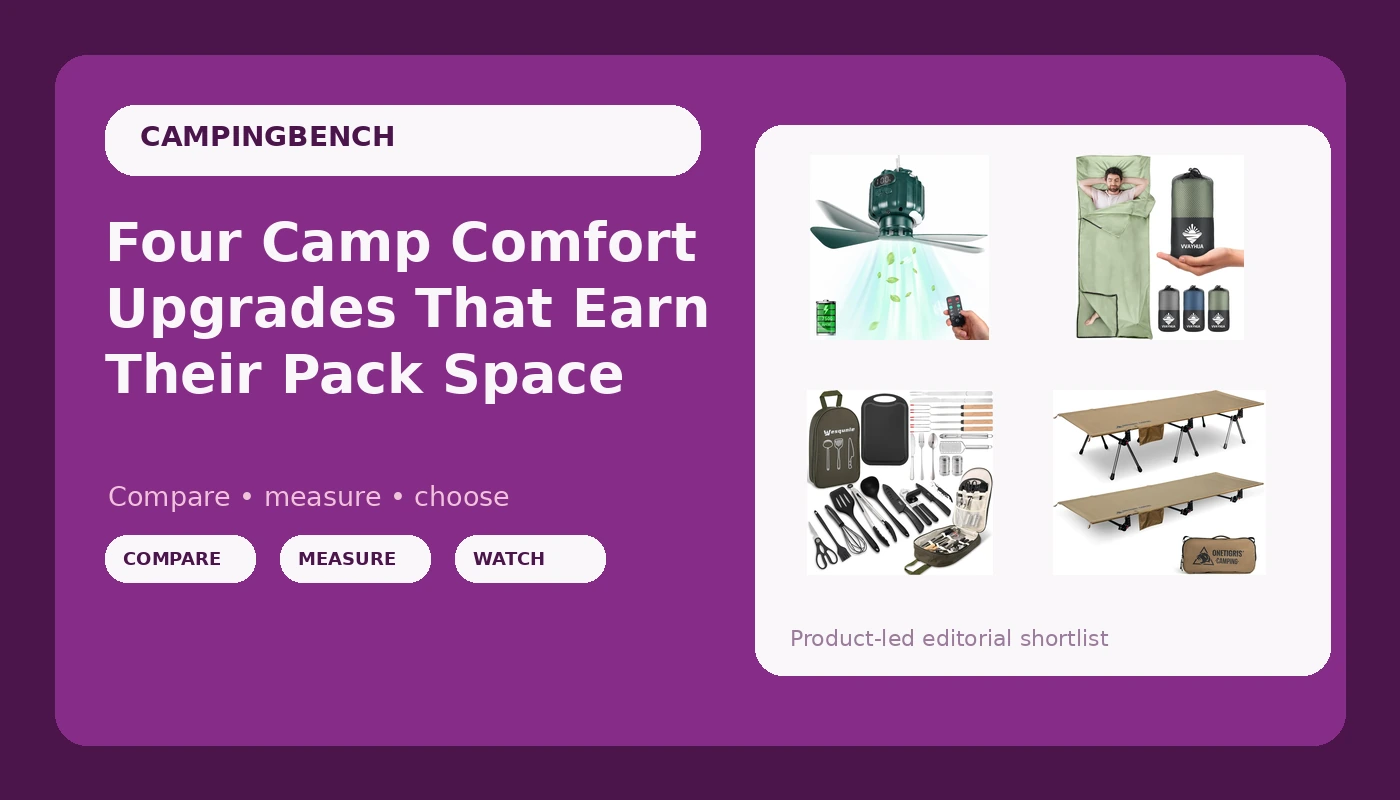
Most camping misery is not dramatic. It is a tent with no air moving through it, a sleeping bag that feels clammy by 2 a.m., a cook kit that turns dinner into a puzzle, and a night on ground that never gets soft. None of those problems require a new tent or a new sleep system. Camp comfort upgrades work because they sit between you and the conditions: a fan, a liner, a cooking set, and a cot.
This is an explainer, not a scoreboard. Four products, four jobs, and an honest look at what each one claims and where each one fits. The question is not which is best. It is which of these solves the problem you keep repeating on the trips you actually take.
Related: Sleeping Pad R-Values Explained →
Quick answer
Buy for the problem, not the category. If the tent turns into an oven by mid-morning, air movement is the fix. If your sleeping bag feels slick against your skin, or you are sleeping in hostel and hotel beds between trips, a liner is the fix. If camp cooking is limited by what you can carry and clean, a compact utensil set is the fix. If the ground itself is what keeps you awake, a cot is the fix. Match the purchase to the failure you keep repeating.
Four useful options
| Model | Best fit | What stands out |
|---|---|---|
| DUKUSEEK Tent Ceiling Fans for Camping Hanging | Still, warm nights inside a tent | Fan, light, remote control, and USB power bank function in one hanging unit |
| Sleeping Bag Liner | Sleeping bag hygiene and shared beds | Two-way zipper that lets you expose your feet separately |
| Wesqunie Silicone Cooking Utensils Set | Camp cooking with limited kit space | Silicone utensils sold as one outdoor cooking set |
| ONETIGRIS SUPRANUBIS Camping Cot | Sleeping off the ground | Height-adjustable legs with cot leg extenders and a listed 330 lb support rating |
Air movement: DUKUSEEK Tent Ceiling Fans for Camping Hanging
A hanging fan is one of the few comfort items that changes a tent's interior without changing the tent. Condensation, still air, and body heat all stack up overnight, and moving that air is often the difference between sleeping and lying awake. The trade-off is honest: this is a battery device, so it needs charging before a trip, and it only earns its place in warm weather. On a cold-weather trip it stays home. On a summer basecamp or a car camping weekend, it is the piece people reach for first.
Sleep surface: Sleeping Bag Liner, Self Tan Sleep Sack
A liner does two jobs at once. Inside a sleeping bag, it keeps body oils and sweat out of the bag's insulation, which is the main reason bags lose loft over a season. On its own, it turns any bed into a known surface, which matters on hostel bunks and hotel stays between trail sections. The two-way zipper with a separate foot opening is the detail that makes it usable in warm rooms, where a fully closed sack gets stifling. Treat it as a hygiene and layering layer, not as a temperature rating.
Camp kitchen: Wesqunie Silicone Cooking Utensils Set
Camp cooking fails on details more often than on food. One spatula that cannot reach the bottom of a pot, one metal tool that scrapes a nonstick surface, one forgotten item that means stirring with a stick. A set solves the "what did I forget" problem in one purchase. Silicone is also quiet and non-scratching against coated cookware, which is why it shows up in camp kits. The trade-off is heat tolerance and rigidity: silicone is not the tool you use to move a heavy pan off coals, so pair it with one sturdy metal piece if your cooking involves open fire.
Sleep platform: ONETIGRIS SUPRANUBIS Camping Cot
A cot is the largest decision in this group and the one with the clearest dividing line. It is a car camping and truck item, not a backpacking item, because a frame and legs will always weigh more than a pad. What it buys you is a flat, level sleeping surface that does not depend on finding soft ground, plus storage space underneath and a place to sit while you pull boots on. Height adjustment and leg extenders matter more than they sound: a cot that rocks on a sloped site is worse than the ground it replaced.
Prices and availability may change. Product images, names, and retailer links must be matched by verified ASIN. Do not state a current price, rating, stock status, or measured result without current evidence.
Comfort gear is a weight and sleep equation
Every item in this group is optional, and that is the point. Base weight, meaning everything in your pack except food, fuel, and water, is what decides how a trip feels. Comfort gear adds to that number, so it has to return something real: better sleep, a warm meal, or a dry tent. The mistake is carrying all of it on every trip.
Think in trip types instead. A backpacking trip rewards a liner and maybe a compact utensil or two. A car camping weekend can absorb a cot, a fan, and a full cooking set without anyone noticing the weight. A hostel and hotel travel week wants the liner alone. The gear does not change; the trip does.
How to read a comfort gear listing
Listings describe intent, not performance. A product name tells you what the seller believes the item is for, and the specification section tells you what is actually claimed. Those are two different things, and the gap between them is where returns come from.
So read for specifics. A support rating, a height adjustment, a zipper configuration, and a power source are checkable facts. Words like lightweight, strong, and comfortable are marketing. Where a listing gives you a number, treat that number as the manufacturer's claim and confirm it against the product page before you buy.
- Name the failure first. Is the problem heat, skin contact, cooking, or hard ground? Buy only for that one.
- Decide the trip type. Backpacking, car camping, or travel lodging. Weight tolerance follows from that.
- Check the specification section against the product name. Confirm every feature you are paying for is listed there.
- Verify the physical envelope. Packed size and setup footprint matter more than headline weight.
- Confirm the return window. Comfort gear is personal, and the first night tells you more than any listing.
Practical guidance
- Weigh your whole kit before you add anything. A comfort item that pushes you over your target is a comfort item you will leave behind.
- Charge battery gear the night before you leave, and carry the cable you actually need, not the whole pouch.
- Test new cookware at home once. Utensils that fail on a kitchen stove will fail at a picnic table too.
- Pitch and assemble a cot at home before a trip. Setup order matters on a dark campsite.
- Wash and dry a liner before storing it. A liner that goes away damp comes back smelling like a warning.
Which option should you choose?
Choose the DUKUSEEK Tent Ceiling Fans for Camping Hanging when still, warm air is what keeps you awake and you have a ceiling loop or hook to hang it from. Choose the Sleeping Bag Liner, Self Tan Sleep Sack when you want to protect a sleeping bag from oils and sweat, or when you are sleeping in hostel and hotel beds between trail sections. Choose the Wesqunie Silicone Cooking Utensils Set when camp cooking is limited by missing tools rather than by a missing stove. Choose the ONETIGRIS SUPRANUBIS Camping Cot when the ground itself is the problem and you are driving to camp rather than carrying everything on your back.
Nothing here is a replacement for a good sleeping pad or a properly rated bag. A fan moves air, a liner adds a layer and a clean surface, utensils make cooking possible, and a cot raises you off the ground. Each solves one problem, and the product names and listings are the source for every feature described above. Confirm the specifications on the product page before you commit.
The bottom line
Camp comfort upgrades work when they are matched to a specific failure. Air movement for a stuffy tent, a liner for a sleeping bag that needs protecting and a bed you do not trust, silicone utensils for a camp kitchen that is always one tool short, and a cot for ground that will not cooperate. Buy the one that matches the night you keep having, not the whole list at once, and check the current Amazon price on the product page before you decide.