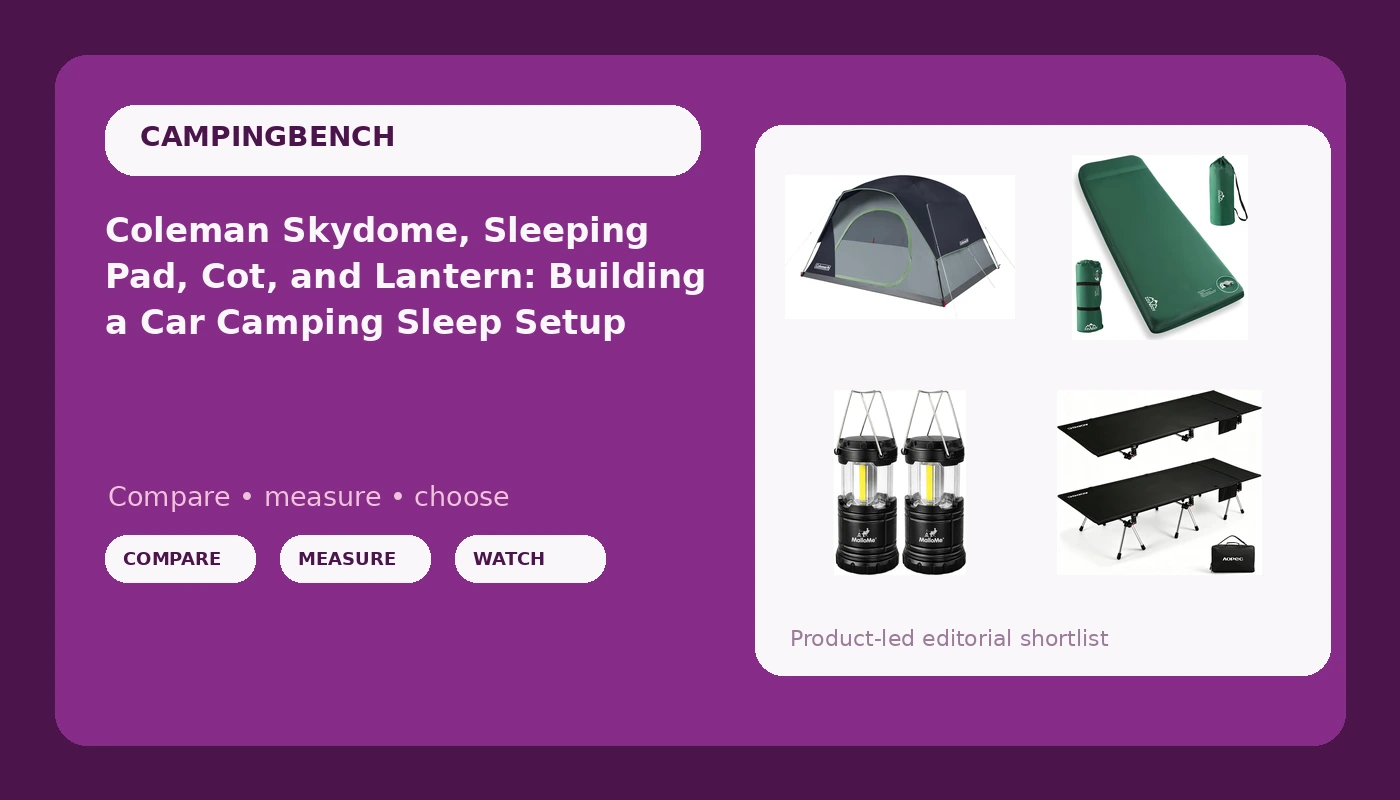
Car camping looks easy until the sun goes down. You have room in the vehicle for almost anything, so the pile grows: a tent, a pad, a cot, a lantern, a second lantern, a mattress topper someone swore by. Then you are standing in the dark at 10 p.m. trying to remember which piece you actually needed. A workable car camping sleep setup is really four separate decisions, shelter, insulation, light, and whether you sleep on the ground at all, and each one changes how the other three feel at 2 a.m. This guide walks through four specific pieces, the Coleman Skydome tent, a memory foam sleeping pad rated 9.5 R-value, the MalloMe LED lantern, and a height adjustable camping cot, and explains what problem each one actually solves.
Related: How to Choose a Sleeping Pad R-Value for Cold Nights →
Quick answer
A car camping sleep setup needs four things: a tent that pitches fast enough to keep you out of the weather, insulation between your body and the cold ground, a light you can hang inside the tent, and a decision about whether you sleep on the ground or up on a cot. The Coleman Skydome covers shelter and quick setup, the memory sleeping pad covers insulation with a 9.5 R-value and a built-in pillow, the MalloMe lantern covers interior light and runs on three AAA batteries, and the height adjustable cot covers the case where you would rather not sleep on the ground at all. Buy in that order, because a great pad inside a tent that leaks is still a wet night.
Four useful options
| Model | Best fit | What stands out |
|---|---|---|
| Coleman Skydome Camping Tent | Shelter for car camping and base camps | Advertised 5 minute setup, rainfly and carry bag included, listed with 20% more headroom than traditional canopies |
| Memory Sleeping Pad, 3.1" Ultra-Thick Foam | Insulation under a sleeping bag | 9.5 R-value, 3.1 inch thickness, self inflating, built-in pillow |
| MalloMe Camping Lights LED Lantern Flashlights | Tent and table light, emergency backup | Battery powered, requires 3 AAA batteries, doubles as a flashlight |
| Height Adjustable Camping Cot | Sleeping off the ground | 350 lbs capacity, heavy-duty aluminum frame, adjustable height |
The shelter: Coleman Skydome Camping Tent
Pitch time is the number most people ignore and then regret. A tent that takes twenty minutes to stand up is a tent you will end up pitching in the rain, because by the time you commit, the weather has already decided for you. The Skydome's advertised five minute setup matters less on a bluebird afternoon and more on the evening when the first drops hit the windshield. The trade-off is honest: this is a car camping tent, so the packed size and weight are the price you pay for the interior volume and the speed. It is not the tent you would want on your back at mile twelve, and it is not trying to be. The headroom claim is worth thinking about too, because a tent you can sit up in is a tent you will actually change clothes in instead of performing a contortion in a sleeping bag.
The insulation: Memory Sleeping Pad, 3.1" Ultra-Thick Foam
R-value is the insulation rating of a sleeping pad, and the higher the number, the warmer you sleep. A 9.5 rating is well above what most three season backpacking pads carry, which tells you what this pad is for: cold ground, car camping, and people who are tired of waking up with a cold hip. The 3.1 inch thickness is the other half of the story, because thickness is comfort and R-value is warmth, and a pad can have one without the other. The trade-off here is bulk. Memory foam and a high R-value add up to a pad that takes up real space in the vehicle and weighs more than a minimalist inflatable. In a car, that is a fine trade. Self inflating pads also generally need a few extra breaths at the end, so plan on topping it off rather than assuming it fills itself completely.
The light: MalloMe Camping Lights LED Lantern Flashlights
Light is the piece people treat as an afterthought and then spend twenty minutes hunting for in a duffel bag. A hanging lantern changes the whole evening: cards on the table, a book in the tent, a headlamp kept free for walking to the bathroom. The catch is right there in the product name. This lantern needs three AAA batteries, and AAA is the size that disappears from the junk drawer first. If you go this route, buy spares and keep them with the lantern rather than in a bag you might leave at home. The other trade-off is output. A lantern this size lights a tent interior comfortably, but it is not a floodlight for a whole group site, and treating it as one will leave you disappointed. As emergency gear it earns its place in a car kit regardless of whether you ever camp with it.
The base: Height Adjustable Camping Cot
A cot is not a replacement for a pad. It is a replacement for the ground, and that is an important distinction. Sleeping elevated gets you away from rocks, roots, and the puddle that forms after a hard rain, and it makes getting up in the morning noticeably easier. But air moves under a cot, and moving air pulls heat away from whatever is on top of it, so the general rule with cots is that you still want insulation between you and the fabric. The 350 lbs capacity and the aluminum frame speak to the other half of cot ownership: durability and pack size. This is a bulky item that lives in the back of a vehicle, not in a backpack, and the adjustable height is most useful when you want the cot to double as a bench during the day.
Prices and availability may change. Product images, names, and retailer links must be matched by verified ASIN. Do not state a current price, rating, stock status, or measured result without current evidence.
What R-value actually means for a car camping pad
R-value measures resistance to heat flow. On a sleeping pad, it describes how well the pad stops your body heat from draining into the ground beneath you. The ground is a heat sink, and it does not care how good your sleeping bag is, because the bag's insulation compresses flat under your weight. That is why the pad does more work on a cold night than most people expect. Ratings are not standardized the way some outdoor gear claims are, so treat any R-value as a manufacturer's figure and compare it against how and where you actually sleep. A 9.5 rating points toward shoulder season and cold weather car camping. If you only camp in July at low elevation, a lower rating would likely be enough, and you would save space in the vehicle.
How to decide between a pad and a cot
This is the question that stalls most first-time car campers, and the answer usually turns out to be "both, in the right order."
- Start with the ground conditions. Rocky, rooty, or poorly drained sites push you toward a cot. Smooth, grassy, and dry sites make a thick pad the simpler answer.
- Count your nights. Two nights a year and a pad is plenty. Ten or more nights and the morning stiffness of sleeping on the ground starts to matter more than the pack size.
- Check your vehicle space. A cot plus a pad plus a tent plus a cooler fills a trunk quickly. Measure before you commit.
- Budget in order of impact. Shelter first, insulation second, light third, cot fourth. A dry tent and a warm pad fix the two problems that ruin trips.
- Test the stack at home. Pitch the tent in the yard, inflate the pad on the cot, and lie on it for twenty minutes before you drive anywhere.
Setting up a car camping sleep system in practice
- Pitch the tent first, before you unpack anything else, so the shelter is standing while you are still dry and unhurried.
- Put the pad or cot on the side of the tent away from the door, and keep the door side clear for boots and bags.
- Hang the lantern from the ceiling loop rather than setting it on the floor, where it will get kicked and dimmed.
- Keep a spare set of the batteries your lantern uses inside the lantern bag, not in a separate kitchen bin.
- Do a two minute walk around the site before dark for widowmakers, low spots, and where water would run if it rains.
Which option should you choose?
Choose the Coleman Skydome Camping Tent when you want a car camping shelter that goes up quickly and gives you room to stand and move inside. Choose the Memory Sleeping Pad, 3.1" Ultra-Thick Foam when warmth and cushioning matter more than packed size, and especially for cold ground in shoulder season. Choose the MalloMe Camping Lights LED Lantern Flashlights when you need a small, cheap interior light that also works in a power outage at home. Choose the Height Adjustable Camping Cot when sleeping on the ground is the part of camping you have stopped enjoying.
None of these four replaces good judgment about where you pitch. The products here are listed features from the manufacturer, not field measurements, and the honest caveat is that a tent's waterproofing, a pad's real warmth, and a lantern's runtime all depend on conditions that no product page can predict for your trip.
The bottom line
A car camping sleep setup is four decisions, not one purchase. Shelter, insulation, light, and the ground question. The Skydome handles shelter and speed, the memory sleeping pad handles warmth with a listed 9.5 R-value, the MalloMe lantern handles light and doubles as emergency gear, and the height adjustable cot handles the nights you would rather not sleep on the dirt. If you are starting from nothing, buy the tent and the pad first, because those are the two pieces that decide whether you sleep at all. Add the lantern before your first trip and the cot when your back asks for it.