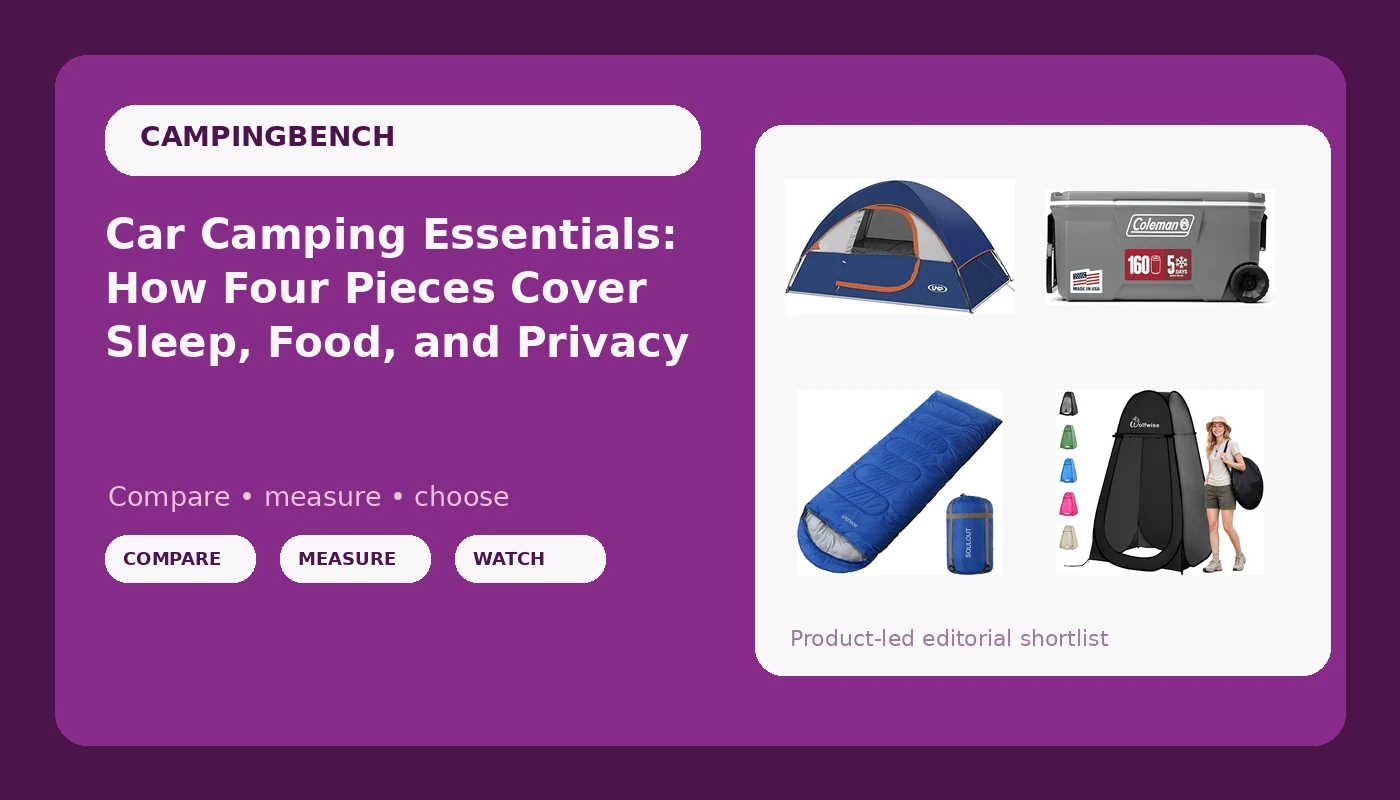
Most first camping trips are not backpacking trips. You park, you unload, and you set up within sight of the vehicle. That single fact changes what gear makes sense. Weight stops being the deciding factor, volume becomes the real constraint, and every item has to earn the space it takes up in a trunk that also holds food, water, chairs, and maybe a dog. The car camping essentials question is not "what is lightest" but "what set of gear covers sleeping, eating, and basic hygiene without swallowing the whole cargo area."
The four products below map onto the four jobs a drive-up campsite actually has to cover: shelter, cold storage, sleep insulation, and privacy. None of them is the right answer for every trip, and none of them replaces a good sleeping pad or a reliable stove. What they do is give you a concrete starting point, plus the reasoning to swap any piece out when your trip looks different from the one they were chosen for.
Related: How to Read a Sleeping Bag Temperature Rating →
Quick answer
For a drive-up campsite, cover shelter and sleep first, then add cold storage and a privacy shelter as your trips get longer. The dome tent handles the sleeping structure for a small group, the rolling cooler handles food and drinks, the three-to-four season sleeping bag handles insulation, and the pop up shower tent handles washing up and changing clothes. Match each one to the job it does rather than trying to find a single product that does everything.
Four useful options
| Model | Best fit | What stands out |
|---|---|---|
| Camping Tent 2-4 Person Dome Tents | Shelter for a small group at a drive-up site | Dome configuration listed for two to four sleepers |
| Coleman Classic Series Insulated Portable Rolling Cooler with Wheels, Leak-Resistant Outdoor Hard Cooler Keeps Ice up to 5 Days | Keeping food and drinks cold without carrying the load | Wheeled, insulated hard cooler; the listing states ice retention up to 5 days |
| SOULOUT 3-4 Season Sleeping Bag for Adults & Teens - Camping | Sleep insulation across a wide range of conditions | Listed by the maker as a 3-4 season bag sized for adults and teens |
| WolfWise Pop Up Shower Tent for Camping Essentials, Compact & Lightweight | Privacy for washing up and changing | Pop up design described in the listing as compact and lightweight |
Shelter: Camping Tent 2-4 Person Dome Tents
The listed capacity is the number worth reading carefully. A tent rated for four people fits four sleeping bags and very little else, so if you are two adults with duffel bags, the four-person end of that range is comfortable and the two-person end is tight. Treat the top of the range as a sleeping count, not a living-space count.
Dome tents trade peak height for stability and simple geometry, which matters more than it sounds. A simpler pole structure means fewer things to get wrong in the dark, and fewer things to get wrong means a shorter pitch when weather is moving in. The other side of the trade is headroom: if you want to stand up inside, a dome is not the shape that gives it to you. If you mainly want a dry place to sleep and dress while sitting, it is.
Cold storage: Coleman Classic Series Insulated Portable Rolling Cooler with Wheels, Leak-Resistant Outdoor Hard Cooler Keeps Ice up to 5 Days
Ice retention claims are where cooler shopping gets slippery. A stated "up to 5 days" figure assumes a set of conditions: a full cooler, cold contents going in, limited opening, and shade. Real trips break those assumptions constantly. The honest way to read the number is as a relative signal, not a promise for your weekend. What you can control is the routine: pre-chill the cooler, pre-chill what goes in, keep it out of direct sun, and open it as rarely as you can stand.
The wheels are the part that matters most for car camping specifically. A loaded hard cooler is heavy, and a long walk from the parking area to the site is exactly where a handle and two wheels change your evening. The trade is footprint: a wheeled hard cooler takes up more trunk volume than a soft bag of similar capacity, so measure your cargo space before committing to a large size.
Sleep: SOULOUT 3-4 Season Sleeping Bag for Adults & Teens - Camping
Season ratings are a broad category, not a temperature. A bag sold as three-to-four season sits somewhere between a light summer bag and a winter bag, and how warm it sleeps for you depends on what you wear, what you sleep on, and how warm you run. That is why the pad underneath matters as much as the bag: insulation below you gets compressed and stops doing its job, so a bag rated generously will still feel cold on bare ground.
For car camping, the practical upside of this category is that it tolerates a wider range of nights than a strictly summer bag, which means one purchase covers spring through fall trips without a second bag. The trade is packed size and bulk. A bag that handles a cold shoulder-season night is not going to compress down to nothing, and in a trunk that is usually an acceptable cost.
Privacy: WolfWise Pop Up Shower Tent for Camping Essentials, Compact & Lightweight
This is the piece people leave off the list and then wish they had on day three. A privacy shelter is not a luxury if you are camping with a group, with kids, or at a busy campground where the bathhouse is a walk away. It gives you a place to change out of damp clothes, rinse off, or set up a small camp shower without an audience.
Pop up shelters are convenient and they fold back down with a specific motion, so the first time you collapse one, do it at home rather than in wind at dusk. The category is also light on structure by design. In strong wind, stake it out and use the guy lines rather than trusting the frame to hold itself upright. Treat it as a fair-weather and moderate-weather convenience, not a storm shelter.
Prices and availability may change. Product images, names, and retailer links must be matched by verified ASIN. Do not state a current price, rating, stock status, or measured result without current evidence.
Why car camping gear is judged differently
Weight is the number that governs backpacking decisions, and it is almost irrelevant here. What governs car camping is volume, setup effort, and how the gear behaves when you are not carrying it anywhere. A six-pound tent that pitches in a few minutes is a perfectly good tent when the car is ten feet away. The same tent would be a poor choice on a thru-hike. Neither judgment is about quality; they are about the trip.
Volume is the constraint people underestimate. A trunk has a fixed number of cubic feet, and bulky items compete with each other. A hard cooler, a large tent, a full-size sleeping bag, and a privacy shelter together can fill a sedan trunk. That is the argument for measuring your actual cargo space before buying, and for thinking about which pieces stack and which pieces only sit flat on the bottom.
Setup effort compounds. Every item that takes twenty minutes to assemble is twenty minutes you spend not eating dinner, and if it starts raining during those twenty minutes, you have a bad evening instead of a mildly wet one. Gear that deploys quickly gets used. Gear that is fussy gets left in the garage, which means the money was spent on nothing.
Weather exposure is the third difference. A drive-up site is often more exposed than a backcountry site, because you are camping in a developed area with fewer natural windbreaks and more open ground. Staking everything out, even when the forecast is calm, is the habit that pays off on the night the forecast is wrong.
Finally, comfort is worth more here than it is on a backpacking trip. You are not paying for comfort in miles walked, so the trade-off that normally limits you disappears. A thicker sleeping bag, a bigger cooler, a chair you can actually sit in: all of it is on the table when the vehicle does the carrying.
How to read a camping product listing before you buy
- Identify the one job the item is supposed to do. Shelter, sleep, cold storage, and privacy are separate jobs, and a product that claims all of them usually does none of them well.
- Check the sizing language. "Two to four person" and "adults and teens" are capacity statements, and the top of a range is a sleeping count rather than a comfort count.
- Note what conditions the maker rates the product for. A three-to-four season bag and a five-day ice retention figure are both category claims that assume specific use, so read them as ranges rather than guarantees.
- Confirm what arrives in the box. Tents, coolers, and shelters differ on whether stakes, guy lines, or straps are included, and missing hardware is an extra errand on the day you leave.
- Match the item to how you actually camp. A rolling cooler is right for a drive-up site and wrong for a walk-in site, no matter how good the insulation is.
Practical guidance for a drive-up campsite
- Pitch the tent before you need it. Set it up once at home to confirm you have all the parts and that you know the pole sequence in daylight.
- Stake everything, including the privacy shelter, even when the evening is calm. Wind arrives without an appointment at exposed campgrounds.
- Pre-chill the cooler and everything going into it. Ice lasts longer when it is not fighting warm food and warm air.
- Sleep on insulation, not just in it. A sleeping bag under you compresses, so the pad does the work your body weight takes away from the bag.
- Keep the sleeping bag dry and air it out each morning. Airing it costs nothing and keeps moisture from building up night after night.
- Leave the site cleaner than you found it. Pack out food scraps and small trash, and check the fire ring before you drive away.
Which option should you choose?
Choose the Camping Tent 2-4 Person Dome Tents when you need a straightforward sleeping structure for a couple or a small group and you are setting up within sight of the car. Choose the Coleman Classic Series Insulated Portable Rolling Cooler with Wheels, Leak-Resistant Outdoor Hard Cooler Keeps Ice Up to 5 Days when food and drink storage is the bottleneck and you would rather roll a loaded cooler than carry it. Choose the SOULOUT 3-4 Season Sleeping Bag for Adults & Teens - Camping when you want one bag that covers spring through fall nights without buying a second bag for shoulder season. Choose the WolfWise Pop Up Shower Tent for Camping Essentials, Compact & Lightweight when privacy for changing and washing up is the missing piece in an otherwise complete setup.
If you are starting from nothing, buy in that order and stop when your trunk is full. Shelter and sleep come first because a cold, wet night ruins a trip faster than warm drinks fix it. Cold storage and privacy are the pieces that make a two-night trip feel comfortable rather than merely survivable, and they are the easiest to add later.
The caveat worth stating plainly: these four products are one coherent combination, not a universal recommendation. Nothing here has been measured in a controlled test, and the ratings quoted above come from the manufacturers' own listings. Use them as a framework for the four jobs, then substitute freely based on your climate, your group size, and how much space your vehicle actually gives you.
The bottom line
A car camping setup works when each piece has a clearly defined job and nothing is duplicated. Shelter, sleep, cold storage, and privacy cover the four needs that most often go unmet on a drive-up trip, and the four products here represent one reasonable answer to each. The dome tent provides the structure, the wheeled cooler handles food and drink, the three-to-four season bag handles insulation, and the pop up shelter handles the parts of camp life that need a wall. Buy the jobs you are missing, skip the ones you already cover, and check current Amazon price before you commit, since listings and availability shift over time.